Showing posts with label Irish Literature. Show all posts

Sunday, January 23, 2022

Danish, Icelandic, Irish Mythologies of Winter: A January Hodgepodge

One thing that's delightful to read across religions, philosophies, and tales is the explanations we have written down for the natural world that surrounds us.

Sitting at my laptop on a grey January day in the Northern Hemisphere, the coal stove fired up, buds still rarer on the oak twigs outside the window, green bulbs beginning to form on the forsythia indoors and a hyacinth bursting into pale pink blossoms on the windowsill, of course looking at winter makes sense. And I'll also reach back further in time than I've done lately on this blog.

***
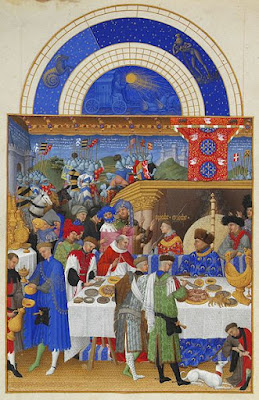
Très Riches Heures du duc de Berry Folio 1, verso: January
("A New Year's Day feast including Jean de Berry")
by the Limbourg brothers (fl. 1402–1416)
via Wikimedia Commons

Pliny the Elder wrote in his Natural History:

Friday, July 16, 2010

Truth in Wilde's Nutshell

Oscar Wilde, 1854-1900
Irish writer

*
The truth is rarely pure and never simple.

— Algernon Moncrieff in The Importance of Being Earnest (1895)
*

Quotations from Oscar Wilde's works, as with any notable writerly quotable, are as popular as they are often apocryphal. I like this one (whose provenance is pretty unequivocal) for its incisiveness, adaptability and freshness; it is an ideal quotation.

On a side note, I wonder why one so often assumes that any line spoken by a character in Wilde's works expresses precisely what Wilde thought himself. Not that the witticisms of Wilde's comedic characters are offensive or uncharacteristic, but we don't assume that the dialogue of a character like Queen Tamora directly portrays the mind of Shakespeare. (Maybe Wilde did believe in resisting temptation, for instance, no matter what Lord Darlington said; though of course even the lord's thoughts are shrouded in ambiguity and we don't precisely know in which degree he was trying to shock, being witty, exaggerating an observation on the reality of the world, or speaking sincerely.)

Or perhaps one doesn't assume it, but is merely attributing the thoughts to Wilde directly to honour him for the acuity and hilarity and refined language of the wording.

It reminds me a little of the engrained half-belief in the actual existence of Sherlock Holmes; our idea of Oscar Wilde, except as a figment of the author's mind and our imaginations, is perhaps every bit as dubious.

[Revised May 27th]