Showing posts with label Theology. Show all posts

Monday, December 01, 2025

A 17th Century German Hymn to Summer

Paul Gerhardt was already a familiar name before I went for a walk around the Nikolaiviertel (St. Nicholas Quarter) here in Berlin, around 2023. But as I was treading setts, rounding the medieval stone church that lent the quarter its name, and looking up at the half-timbered houses cuddled around the house of worship,* I was surprised to find a plaque to Gerhardt. — *That said, the church and houses were in fact rebuilt here from post-World War II ruins by the former German Democratic Republic when Berlin celebrated its 750th anniversary in the 1980s. They are not the originals that a visitor would have seen in the Baroque period. — In a way he was a Berliner; he moved here after studying at the University of Wittenberg, in 1643. Starting in 1657, he was employed as the pastor of the Nikolaikirche.

He was a Lutheran theologian and hymn writer whose oeuvre is still known today. A few of his verses — written in the clear and peculiarly grounded style of his generation — are standard modern Christmas repertoire, with fittingly beautiful musical settings, in Germany. "Wie soll ich dich empfangen" and "Ich steh' an deiner Krippen hier"** are perhaps the most famous.

Perhaps they are also especially poignant because of the difficult times in which Paul Gerhardt lived. To quote from Wikipedia:

Wie viele andere Familien in Kursachsen hatten auch die Gerhardts unter den Folgen des Dreißigjährigen Krieges – Hungersnot, Seuchen und den Übergriffen der Soldaten – zu leiden. 1619 starb sein Vater, 1621 seine Mutter.

In other words: the Gerhardts had settled in Saxony-Anhalt during the Thirty Years' War. His family suffered from famine, pestilence, and marauding soldiers, to the point that his parents both died by the time he was 15 years old. Paul had an older brother and two younger sisters at the time, the article adds. The rest of his biography, a litany of personal tragedy, also has overtones of Voltaire's Candide.

Even decades later, when Gerhardt arrived in Berlin in 1643, the Thirty Years' War was still being fought, and the fighting as well as dysentery, a plague, and smallpox had reduced the city's population by more than half. So, although of course interpreting authors' works through their biographies is rather more of a 19th-century approach than an approach that 21st-century literary theoreticians would support, I will venture to say it is for this reason that there is always a chiaroscuro, in the sense of blended effects of light and darkness, in Gerhardt's works.

** "Wie soll ich dich empfangen" was scored by Johann Sebastian Bach in his Christmas Oratorio as well as by Johann Crüger; I like both settings, and recordings of both are easily discoverable on YouTube. "Ich steh' an deiner Krippen hier" has also been 'done' by Bach, as well as by Georg Christian Schemelli.

A bright painting of workers shearing sheep, an old house, and fields and a castle in the background
Labors of the Months: June, from a Flemish Book of Hours (Bruges)
Painted in early 16th century by Simon Bening
via Wikimedia Commons

*

Rather than dwell on Paul Gerhardt's well-known Advent songs, I want to write about a summer poem, "Geh aus, mein Herz, und suche Freud." — In German one would call its subject matter a Kontrastprogramm ('programme of contrast') to the drab weather of a north German November.

For brevity's sake, I'm only offering rough translations of the first seven verses of the original fifteen. For indolence's sake, I've not even attempted to keep the AABCCB rhyme scheme.

Geh aus, mein Herz, und suche Freud
in dieser lieben Sommerzeit
an deines Gottes Gaben;
Schau an der schönen Gärten Zier,
und siehe, wie sie mir und dir
sich ausgeschmücket haben.

Go forth, my heart, and search for joy / in this dear summer time / from your God's gifts; / Look on the pretty gardens' ornament, / and see how they, for me and you, / have put on decorations.

Die Bäume stehen voller Laub,
das Erdreich decket seinen Staub
mit einem grünen Kleide;
Narzissus und die Tulipan,
die ziehen sich viel schöner an
als Salomonis Seide.

The trees stand full of leaf / the earthen realm has decked its dust / with a green dress; / daffodil and tulip, / these put on their clothes more beautifully / than Solomon his silk.

Die Lerche schwingt sich in die Luft,
das Täublein fliegt aus seiner Kluft
und macht sich in die Wälder;
die hochbegabte Nachtigall
ergötzt und füllt mit ihrem Schall
Berg, Hügel, Tal und Felder.

The lark wings into the air, / the little dove flies from its rocky cleft / and makes for the woods; / the highly skilled nightingale / amuses and fills with her sound / the mountain, valley, hills, and fields.

Die Glucke führt ihr Völklein aus,
der Storch baut und bewohnt sein Haus,
das Schwälblein speist die Jungen,
der schnelle Hirsch, das leichte Reh
ist froh und kommt aus seiner Höh
ins tiefe Gras gesprungen.

The mother hen leads out her folk, / the stork builds and tenants his house, / the swallow feeds her young, / the fleet stag, the light-footed deer / is joyous and comes down from its height / leaping into the deep grass.

Die Bächlein rauschen in dem Sand
und malen sich an ihrem Rand
mit schattenreichen Myrten;
die Wiesen liegen hart dabei
und klingen ganz vom Lustgeschrei
der Schaf und ihrer Hirten.

The little brooks rush in the sand / and paint themselves upon their banks / myrtles full of shadows; / the meadows lie fast by / and fairly ring from happy cries / of sheep and of their shepherds.

Die unverdrossne Bienenschar
fliegt hin und her, sucht hier und da
ihr edle Honigspeise;
des süßen Weinstocks starker Saft
bringt täglich neue Stärk und Kraft
in seinem schwachen Reise.

The unperturbed swarm of bees / flies to and fro, seeking here and there / its fine repast of honey; / the sweet grapevine's rich juice / daily brings new strength and force / in its feeble shoot.

Der Weizen wächset mit Gewalt;
darüber jauchzet jung und alt
und rühmt die große Güte
des, der so überfließend labt,
und mit so manchem Gut begabt
das menschliche Gemüte.

The wheat grows with mighty force; / young and old rejoice thereat/ and praise the great goodness / of him, who refreshes so abundantly, / and many a good thing bestows / upon the human spirit.

Friday, April 18, 2025

A Thoreau Thought for Easter

It may be a passage from the end of an essay by Henry David Thoreau that I have not fully read ("Walking," from the 1850s). It may be describing a scene that Thoreau saw in November. It may also be a bit of a mishmash between ancient Greek and 19th-century American Christian religion.

Springtime (early 1920s), by Ugo Flamiani
via Wikimedia Commons

But I think that this sprig of nature philosophy still feels timely, as I enter the Easter weekend:

We walked in so pure and bright a light, gilding the withered grass and leaves, so softly and serenely bright, I thought I had never bathed in such a golden flood, without a ripple or a murmur to it. The west side of every wood and rising ground gleamed like the boundary of Elysium, and the sun on our backs seemed like a gentle herdsman driving us home at evening.

So we saunter toward the Holy Land, till one day the sun shall shine more brightly than ever he has done, shall perchance shine into our minds and hearts, and light up our whole lives with a great awakening light, as warm and serene and golden as on a bank-side in autumn.

The essay — although Thoreau had read it aloud in lecture halls before — was first printed shortly after his death, in 1862.

***

Source: Essays and Other Writings of Henry David Thoreau. Will H. Dircks, ed.
     London: Walter Scott Press

Sunday, January 23, 2022

Danish, Icelandic, Irish Mythologies of Winter: A January Hodgepodge

One thing that's delightful to read across religions, philosophies, and tales is the explanations we have written down for the natural world that surrounds us.

Sitting at my laptop on a grey January day in the Northern Hemisphere, the coal stove fired up, buds still rarer on the oak twigs outside the window, green bulbs beginning to form on the forsythia indoors and a hyacinth bursting into pale pink blossoms on the windowsill, of course looking at winter makes sense. And I'll also reach back further in time than I've done lately on this blog.

***

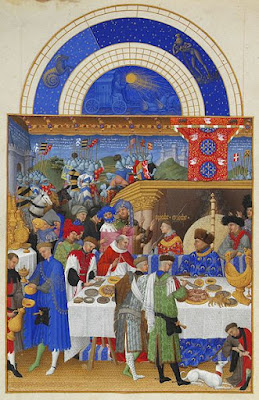
Très Riches Heures du duc de Berry Folio 1, verso: January
("A New Year's Day feast including Jean de Berry")
by the Limbourg brothers (fl. 1402–1416)
via Wikimedia Commons

Pliny the Elder wrote in his Natural History:

Sunday, November 28, 2021

In the Bleak Midwinter, in a Nutshell

Christina Rossetti, one of the clan of Pre-Raphaelites, wrote a religious poem that has since been set to music by Gustav Holst and others, and turned into a Christmas hymn.

I've not entirely been a fan of her writing style, which in the first verse of this poem has a kind of literally lapidary Cubist quality even if she was writing decades earlier, in the 19th century. But it is undoubtedly also moving.

From Pre-Raphaelitism and the pre-Raphaelite brotherhood (1905)
Likely by William Holman Hunt, via Wikimedia Commons

In the bleak mid-winter

Frosty wind made moan,
Earth stood hard as iron,
Water like a stone;
Snow had fallen, snow on snow,
Snow on snow,
In the bleak mid-winter,
Long ago.

Night
by Edward Burne-Jones
via Wikimedia Commons

Our God, Heav’n cannot hold him
Nor earth sustain;
Heav’n and earth shall flee away
When he comes to reign:
In the bleak mid-winter
A stable-place sufficed
The Lord God Almighty
Jesus Christ.

[...]

What can I give him,
Poor as I am?
If I were a shepherd
I would bring a lamb,
If I were a Wise Man
I would do my part,
Yet what I can I give him,
Give my heart.

***

To me, an element of William Blake's mysticism tinges the second verse: having an idea of religion in which there is always a conflict or a wrangling for a central role, the Tyger and the Lamb. Maybe inspired by Paradise Lost?

I see this portrait of conflict as projecting a personal struggle with faith, or with the world. Seen as an 'objective' reader of the poem: why, in a Christian cosmology, can't a loving God coexist with heaven and earth?

It's also unclear why Jesus would expect gifts; but that might be just my opinion, influenced by my Black Friday season anti-consumerism.

*

'Pre-Raphaelite window
in Highfield United Reform Church, Rock Ferry'
In the Pre-Raphaelite style.
via Wikimedia Commons

The King's College Choir at Cambridge recorded a rather fine version of Holst's musical setting in 2005, and it is available on YouTube.

In the Bleak Midwinter (1872) [Wikipedia]

Sunday, August 16, 2020

Sunday Theology: A Jewish Prayer in Isaac Bashevis Singer's Poland

Before I cut short the reading in German translation of Isaac Bashevis Singer's novel The Magician of Lublin, I copied a quotation into my notes:

"Was sind wir, was unser Leben, was unsere Gnade? Was unsere Frömmigkeit, was unsere Hilfe, was unsere Kraft, was unsere Stärke? … Alle Helden sind wie nichts vor dir, die berühmten Männer, als ob sie nie gewesen, die Weisen wie ohne Erkenntnis, die Einsichtigen wie ohne Verstand, denn die Menge ihrer Werke ist eitel, und die Tage ihres Lebens sind nichtig vor dir."

These words are spoken in a place of worship by an Orthodox Jewish man who is praying by himself. The character of the Magician (who is wrestling, like the author himself, with contradictory forces of secularism and faith) overhears him on one of his journeys from Lublin.

To translate roughly: What are we, what is our life, what is our mercy? What our piety, what our assistance, what our power, what our might? ... All heroes are as nothing before you, the famous men are as if they never existed, the wise are without knowledge, the perceptive without reason, for the mass of their works is in vain, and the days of their lives are nothing before you.

Whether it is an excerpt from a known religious text, as I assume, or Singer's own composition, I was struck by it.

From a literary perspective, its words are weighty. Atmospherically I feel pathos in it — a sadness about not living up to an individual ideal — rather than a brutal denial of humanity at large, although this is debatable.

What I like in a subjective, non-literary way is the sense of proportion of a human's role in the history of the world, and in the width and breadth of the present time. It appears healthy to follow a religion or philosophy that is not meant to coddle and feed ego, but rather to help us look beyond ego.

I also like the idea of a God who is forceful enough to influence our lives through the quieter inner paths of conscience and the path of outer events without clear cause and effect, not a thin-skinned, fragile narcissist who relies on human propaganda, vigilanteism and perpetual obeisance to achieve the good. (Whatever that good may be.)

On the other hand, I may have quoted before the thought that God is infinitely small as well as infinitely great. We do not need to worship a Nietzschean superman.

*

On second thought, writing about a Jewish prayer on Sunday may be clumsy. So apologies for that, as well as for the perhaps frivolous habit of picking and choosing from religions what interests me and what doesn't, and offering an uneducated opinion without taking into account what the reactions may be.

Source: Der Zauberer von Lublin, by Isaac Bashevis Singer. Translation by Susanna Rademacher. Reinbek bei Hamburg: Rowohlt, 2017.

Sunday, May 24, 2020

The Bach Motet: Jesu, meine Freude

A colleague sent me a new recording of a Bach motet. Aside from the anti-coronavirus masks worn by all the singers, as they stand and perform in a church in Prague for the Spring Festival, on May 18th this year; and aside from the quality of the singing of music, which had been unknown to me before; what struck me was the lyrics.

J.S.Bach - Motet: Jesu, meine Freude BWV 227 - Collegium 1704
[YouTube: Bachology,
May 22, 2020]

While Baroque-era Christianity had its fanatic aspects, and the wars of religion were terrible, I find hymns like the ones that were incorporated in the motet touching and sympathetic. They attempt to come to terms with the worst of humanity and the best of existence, all in one. To me they seem like an example of the massive efforts that men made in the 17th century, perhaps more than we do today.

Written by Johann Franck, the hymns in the motet were written in the middle of the 1600s. They are simple in construction: an aab ccb dee rhyme scheme, for example, mostly emphasized in trochees.

I tend to like the first two or three lines of each hymn best. For example, at the beginning of the motet:
Jesu, meine Freude,
Meines Herzens Weide,
The 'pasture of the heart' is tranquil and idyllic, insofar as it makes me think of a landscape painting with a grazing cow shaded by tall, old-growth trees. Why the thought of a cow should feel poetic, rather than reminiscent of milk and steak, I don't know.
Unter deinem Schirmen
Bin ich vor den Stürmen
Aller Feinde frei.
is also pleasant. (To translate roughly: 'Beneath your shelters, I am free of the storming of all foes.' The Bachology YouTube video presents a more elegant translation: "Beneath your protection/I am free from the attacks/of all my enemies.")

Sunday, January 13, 2019

The Orderly God in Leibniz's Vision

Discourse on Metaphysics
by Gottfried Leibniz, translated by George Redington Montgomery
Discours de métaphysique (1686) GP iv 427-463
via Wikisource

Gottfried Wilhelm Leibniz wrote this treatise in 1686 during a letter exchange with a French fellow philosopher, Antoine Arnauld. It wasn't published until over a century later. So I surmise it didn't play a role in founding Leibniz's reputation as a philosopher who rather heartlessly argued that the world is perfection and that, by implication, anyone who suffers or rebels against it is too thick to understand God's machinery. Leibniz was 40 at the time of writing; his influential work Monadologie was produced about 30 years later, and Candide, Voltaire's riposte, was published in 1759.

Turning to Bertrand Russell's History of Western Philosophy, I see that Leibniz's chapter begins on a firm note: firstly, the German philosopher was apparently "not admirable" as a person. Also, part of Leibniz's work was meant to appeal to his royal patrons and not to 'rock the boat,' which mined its worth from a philosophical point of view.
It was the popular Leibniz who invented the doctrine that this is the best of all possible worlds
***

Here Leibniz sets out his Logical God, and a Connect The Dot metaphor:
VI. That God does nothing which is not orderly, and that it is not even possible to conceive of events which are not regular.The activities or the acts of will of God are commonly divided into ordinary and extraordinary. But it is well to bear in mind that God does nothing out of order. Therefore, that which passes for extraordinary is so only with regard to a particular order established among the created things, for as regards the universal order, everything conforms to it. This is so true that not only does nothing occur in this world which is absolutely irregular, but it is even impossible to conceive of such an occurrence. Because, let us suppose for example that some one jots down a quantity of points upon a sheet of paper helter skelter, as do those who exercise the ridiculous art of Geomancy; now I say that it is possible to find a geometrical line whose concept shall be uniform and constant, that is, in accordance with a certain formula, and which line at the same time shall pass through all of those points, and in the same order in which the hand jotted them down; also if a continuous line be traced, which is now straight, now circular, and now of any other description, it is possible to find a mental equivalent, a formula or an equation common to all the points of this line by virtue of which formula the changes in the direction of the line must occur. There is no instance of a face whose contour does not form part of a geometric line and which can not be traced entire by a certain mathematical motion. But when the formula is very complex, that which conforms to it passes for irregular. Thus we may  say that in whatever manner God might have created the world, it would always have been regular and in a certain order. God, however, has chosen the most perfect, that is to say the one which is at the same time the simplest in hypotheses and the richest in phenomena, as might be the case with a geometric line, whose construction was easy, but whose properties and effects were extremely remarkable and of great significance.
***
Gottfried Wilhelm Leibniz, c. 1700
Portrait by Johann Friedrich Wentzel (1670–1729)
via Wikimedia Commons

***

Russell argues against using God as a logical solution to philosophical problems.
The God of the Old Testament is a God of power, the God of the New Testament is also a God of love; but the God of the theologians, from Aristotle to Calvin, is one whose appeal is intellectual: His existence solves certain puzzles which otherwise would create argumentative difficulties in the understanding of the universe. This Deity who appears at the end of a piece of reasoning, like the proof of a proposition in geometry, did not satisfy Rousseau, who reverted to a conception of God more akin to that of the Gospels.
Leibniz, I gather, runs the risk of not loving his fellow man enough to consider God's purpose in light of man's welfare, and of seeing God in the bloodless way Russell describes.

Furthermore, the British philosopher counters the 'best of all worlds' argument as efficiently as Voltaire. First he recapitulates the Leibnizian reasoning: God made a world that has evil too, rather than all good, he writes; and
That is because some great goods are logically bound up with certain evils.
He further explains Leibniz's point with this example: a drink of water would not be appreciated as a great good if one were not thirsty.

In short:
The world that resulted [from God's decision] [...] has a greater surplus of good over evil than any other possible world; it is therefore the best of all possible worlds, and the evil that it contains affords no argument against the goodness of God.
But Russell then argues that this line of reasoning is self-interested. It might appeal to Leibniz himself and to Leibniz's patrons, but not to much of the rest of the world:
This argument apparently satisfied the Queen of Prussia. Her serfs continued to suffer the evil, while she continued to enjoy the good,* and it was comforting to be assured by a great philosopher that this was just and right.
My father and I once talked about a different metaphor for an organized/disorganized world: If we inspect a carpet from beneath, as human beings do when we look at the world, we see the frayed ends of yarn, the unfinished appearance, etc. Whereas a being who is looking at the carpet from the top, like God, is seeing and understanding the pattern. Not that I remember Papa presenting this belief as his own; he was discussing it as an illustration.

I like the Connect the Dot metaphor, too. But I think I'd substitute the modern metaphor of 'not seeing the forest for the trees.' When the world is composed of many elements, it can be hard to see patterns and organization that may exist.

***

"Bertrand Russell Smoking A Pipe"
"The Welsh philosopher and mathematician Bertrand Russell smoking the pipe while sitting on an armchair. 1954 (Photo by Mondadori Portfolio via Getty Images)"
via Wikimedia Commons

***

My two cents: I'm not entirely opposed to the idea that "What I do thou knowest not now; but thou shalt know hereafter" — that it is possible to believe in a God whose reasoning is not always understandable but might be explained to us in the afterlife. That said, I object very much to human beings explaining away the hardships of others, by attempting to intuit God's reasoning themselves. I think that it's nicer to have the sense to see that this is a tricky endeavour, and have the compassion to see that it should not be undertaken if it makes people feel even worse.**

Sources:
"Discourse on Metaphysics" [Wikipedia]
"Monadology" [Wikipedia]
"Leibniz" in The History of Western Philosophy, 2nd ed., by Bertrand Russell (London: George Allen + Unwin, 1979), pp. 563-576
John 13.7, King James Bible [Kingjamesbibleonline.org]

* (His premise that Queen of Prussia was happier than her subjects because she was richer is not watertight. But I agree that the world might make far greater sense to her, because it feels materially fulfilling, than it would to a peasant to whom it feels materially precarious.)
** I should state that I am not thinking of specific examples of this behaviour! — this is not a passive-aggressive allusion or 'subtweet.'

Friday, May 04, 2018

Voltaire on the Wars of Catholics and Protestants

In his article "Climate" from the Philosophical Dictionary (1764), Voltaire argues that the weather, the natural environment, and of course other causes greatly influence religious beliefs in different countries and regions. They influence the creed behind the religion, and they also influence the way the religion is practiced in its daily details.

He gives this nutshell summary of the Thirty Years' War — it is so frivolous and glib about a horrendous historical period that it is funny again:
"What cause detached the north of Germany, Denmark, three-quarters of Switzerland, Holland, England, Scotland, Ireland, from the Roman communion? Poverty. Indulgences and deliverance from purgatory were sold too dear to souls whose bodies had at that time very little money. The prelates, the monks devoured a province's whole revenue. People took a cheaper religion. At last, after twenty civil wars, people believed that the Pope's religion was very good for great lords, and the reformed religion for citizens."

From: Voltaire, The Philosophical Dictionary. H.I. Woolf, ed. New York: Knopf, 1924
via Hanover Historical Texts Project

***

In French:

Quelle cause a détaché le nord de l’Allemagne, le Danemark, les trois quarts de la Suisse, la Hollande, l’Angleterre, l’Écosse, l’Irlande, de la communion romaine ?... la pauvreté. On vendait trop cher les indulgences et la délivrance du purgatoire à des âmes dont les corps avaient alors très-peu d’argent. Les prélats, les moines, engloutissaient tout le revenu d’une province. On prit une religion à meilleur marché. Enfin, après vingt guerres civiles, on a cru que la religion du pape était fort bonne pour les grands seigneurs, et la réformée pour les citoyens. 

From: Voltaire, Œuvres complètes de Voltaire, Vol. 18. Garnier, 1878 (pp. vii-xi).
via Wikisource

Sunday, November 03, 2013

Physiologus's Salamander

THIS time the literary text discussed on this 'Alexandrian' site does, in fact, come from Alexandria. Last year in university, the teacher of a Byzantinian folk literature course started his semester by presenting three tales from Physiologus.

One fable reminded me particularly of end of the Voyage of the Dawn Treader (the healing sun berries that are carried to the old star by the firebird) and C.S. Lewis's other Narnia books, and in retrospect the Wikipedia article clarifies that Physiologus, written apparently before the final downfall of the Western Roman Empire in the 5th century A.D., is in fact the origin of Christian beast myths which are present throughout Europe even in these centuries.

Saturday, June 08, 2013

Master Drawings V: Cain and Abel

The fifth part of a series, exploring literature which springs to mind when looking at works in the Master Drawings exhibition which is running in England from May 25 to August 18, 2013. This time the arts-and-literature pair is Francisco Goya's Cain and Abel and an American author's "Woodman, Spare That Tree!" The painting is not apparently much written about, though I was able to read* that it was created around 1817-20, and not much photographed. So other paintings will have to suffice for this blog post.

To begin, a potted biography of the artist:

Goya's earliest paintings, like La cometa from 1777 or 1778, are residue of the Rococo era in their peaceful boisterousness, but his style changed considerably and with conviction. Not as successful as he had hoped at first, he lived and worked in Italy as well as in Spain; then he gained recognition in the 1780s and at last became a court painter in 1789. Despite his comfortable situation he was clearly by no means complacent; according to the wisdom of Wikipedia, "His portraits are notable for their disinclination to flatter, and in the case of Charles IV of Spain and His Family, the lack of visual diplomacy is remarkable.[Footnote: Licht, Fred: Goya: The Origins of the Modern Temper in Art, page 68. (...)]." Around 1793 he lost his hearing and this seems to have been a watershed for the mounting darkness in his artistic efforts, too. With the turmoil of politics and armed conflict as Spanish subjects became fodder to the juggernaut of the Napoleonic Wars in 1807 and until 1814, war scenes began to be a focus. Even before that he had drawn tortuous scenes of prisoners. Nevertheless he had continued as a painter under the French occupation — though one of his projects at the end of these years was a uniformed oil-on-mahogany of Wellington — and harboured some sympathies for the Revolution; and apparently relations to the royal family were lastingly strained. He died in the year 1828 in Bordeaux.

Illustration: Colossus by Francisco de Goya (1746–1828)
(Painted 1808-1810, oil on canvas, 116 × 105 cm; in the Museo del Prado [via Wikimedia Commons])

ON the one hand,

Monday, May 27, 2013

Master Drawings I: Jerome

In honour of the incipient Master Drawings exhibition at the Ashmolean in Oxford, I have decided to append a string of texts or books to some of the pictures which I find most striking, culled from the exhibition slideshow on the Guardian website.

The first is Lucas van Leyden's rendering of Jerome, the saint who is said — historically speaking — to have roamed the Mediterranean brink from somewhere between 347 – 420 A.D. Van Leyden was, aptly enough, of Leyden in the Netherlands; he lived from 1494 to 1533 and thus was a contemporary of Albrecht Dürer, who drew his picture.

The text is from the Golden Legend (Jacobus de Voragine, c. 1275), as it was transferred into English by William Caxton in the 15th century and edited by F.S. Ellis into the tolerably comprehensible modern tongue.

Illustration: Saint Jerome (1521) by Lucas van Leyden, from the Ashmolean [Source: Wikimedia Commons]
***

St. Jerome and the Lion

"ON a day towards even1 Jerome sat with his brethren for to hear the holy lesson, and a lion came halting suddenly in to the monastery, and when the brethren saw him, anon they fled, and Jerome came against him as he should come against his guest, and then the lion showed to him his foot being hurt. Then he called his brethren, and commanded them to wash his feet and diligently to seek and search for the wound. And that done, the plant2 of the foot of the lion was sore hurt and pricked with a thorn. Then this holy man put thereto diligent cure, and healed him, and he abode ever after as a tame beast with them.

Then St. Jerome saw that God had sent him to them, not only for the health of his foot, but also for their profit, and joined to the lion an office3, by the accord of his brethren, and that was that he should conduct and lead an ass to his pasture which brought home wood, and should keep4 him going and coming, and so he did. For he did that which he was commanded, and led the ass thus as a herdsman, and kept him wisely going and coming, and was to him a right sure keeper and defender, and always at the hour accustomed he and the ass came for to have their refection5 and for to make the ass to do the work accustomed.

ON a time it happed that the ass was in his pasture, and the lion slept fast, and certain merchants passed by with camels and saw the ass alone, and stole him and led him away. And anon after, the lion awoke and when he found not his fellow, he ran groaning hither and thither, and when he saw that he could not find him he was much sorrowful and durst not come in, but abode at the gate of the church of the monastery, and was ashamed that he came without the ass.

And when the brethren saw that he was come more late than he was wont6, and without the ass, they supposed that by constraint of hunger he had eaten the ass, and would not give to him his portion accustomed, and said to him: Go and eat that other part of the ass that thou hast devoured, and fill thy gluttony.

And because they doubted, and they would wit7 if he had so eaten, they went to the pastures of the town to see if they could have any demonstrance of the death of the ass, and they found nothing, and returned and told it to Jerome, and then he commanded them to enjoin him to do the office of the ass8. Then they hewed down bushes and boughs and laid upon him, and he suffered it peaceably.

Sunday, May 05, 2013

To the Young (and Catholic) Amongst Us

I wanted to translate the 'tweets' of Pope Francis's Italian Twitter account, from April 26 - May 3, 2013, copied them into Google Translate, and found that I rather liked the result in literary terms.

(Of course these tweets come in an official English version, too. Still, I assume, for no direct reason, that the Italian text is the prototype.)

In terms of the content, the virtues of prayer are a familiar theme, of course. But I like the mixing of partly quite traditional, partly not so traditional thoughts.

In any case, I am still happy about the new Pope, particularly since being baptized Catholic, and thereby associated with the Church, is an uneasy thing at times from a moral standpoint.

*

It would be nice, in the month of May, to recite the Holy Rosary together in the family. Prayer makes even stronger family life.

I think of those who are unemployed, often because of a selfish mentality that seeks profit at any cost.

Dear young people, learn from St. Joseph, who has had difficult times, but he never lost faith, and has been able to overcome them.

We have faith in God! With Him we can do great things, therein he will make us feel the joy of being his disciples.

How nice if each of us in the evening could say: Today I made a gesture of love for others

The Holy Spirit transforms us and really wants to transform, through us, the world in which we live.

Dear young people, don't bury the talents, the gifts that God has given you! Do not be afraid to dream big things!

***

In the Italian, the same quotations:

Sunday, August 19, 2012

The Fox and the Geese

Fox once came upon a meadow where a herd of lovely fat geese was sitting. He laughed and said, "I have come at the right time. You are sitting together so nicely that I can eat you up one after the other." The geese quacked with affright, leapt to their feet, and began to wail and plead piteously for their lives. Fox, however, refused to listen to them and said, "There will be no mercy here! You must die." At last one of them took heart and said, "If we poor geese are to lose our lives in the flower of youth, grant us one favour and allow us a prayer, so that we do not die with our sins upon us; and afterwards we will even set ourselves in a row so that you may always choose the plumpest." — "Very well," said Fox, "that is fair and it is a pious request. Pray; I will wait that long." So the first started a pretty long prayer, always "Gah, gah," and because she refused to stop, the second did not wait for her turn, but also started: "Gah, gah!" The third and fourth followed her example, and soon they were all quacking together. (And when they have prayed themselves out, this tale shall be told further; but they are still perpetually praying on.)

Original text: "Der Fuchs und die Gänse," Jacob and Wilhelm Grimm
in the Kinder- und Hausmärchen (Bayreuth: Gondrom Verlag, 1982)

THE END

Sunday, August 21, 2011

The Moon

From the Grimm fairy tales, a little cosmogony:

***

Once there was a land where the night was always dark and the sky was spread over it like a black cloth, for the moon never rose there and no star winked in the darkness. At the creation of the world the light of night had been sufficient. From this land, four lads once went wandering and arrived in another realm, where in the evening, when the sun had vanished behind the mountains, a glowing sphere stood on an oak tree, pouring out a soft light far and near. People could see and tell apart everything very well in it, even though it was not as bright as the sun. The wanderers stood still and asked a farmer, who was driving past with his cart, what sort of light that was. "That is the moon," the man answered. "Our mayor bought it for three Talers and fixed it to the oak tree. He must pour oil to it daily and keep it clear, so it always burns brightly. For that, we give him a Taler every week."

When the farmer had driven away, one of them said, "We've a use for this lamp. At home we have an oak tree that is exactly as large; we can hang it on there. What a joy it will be not to tap around in the darkness at night!"

"Do you know," said the second, "we'll fetch a cart and horse and carry off the moon. These people here can buy themselves another one."

"I climb well," said the third, "I'll fetch it down proper."

The fourth fetched a cart with horses and the third climbed up the tree, drilled a hole into the moon, pulled a rope through it and lowered it down. When the shining sphere lay in the cart, they covered it in a cloth so that no one would notice the theft. They brought it happily to their land and set it onto a tall oak. Old and young were happy when the new lamp sent its light glowing over all the fields and filled the halls and chambers with it. The dwarves came out from their caves, and the little brownies danced rings on the meadows in their red frocks.

The four supplied the moon with oil, cleaned the wick and received their Taler every week. But they became old men, and when one of them sickened and foresaw his death, he commanded that the fourth part of the moon be given into the grave with him, as his property. When he had died, the mayor climbed into the tree and cut off a quarter with his hedge shears, and it was laid in the coffin. The light of the moon fell off, but not noticeably yet. When the second died, the second quarter was given with him, and the light diminished. It was even weaker after the death of the third, who equally took his part with him, and when the fourth entered the grave, the old darkness set in again. When people went out without a lantern of an evening, they bumped their heads together.