Saturday, October 30, 2021

November 2021 In Books: What I'll Be Reading

After the Nobel Prize in Literature was announced, it would make sense to read the writings of Abdulrazak Gurnah.

And in September Colson Whitehead published Harlem Shuffle, set in New York City in the 1960s.

Cover of Harlem Shuffle
via Doubleday

For the would-be archaeologist like me, Lara Maiklem's Field Guide to Larking is also a tempting new book (published longer ago in August, it should be mentioned).

But I will continue to dig into a reading backlist instead of reading newer publications. There are the Complete Tales of Beatrix Potter to finish, and the list of best books of 2020 from National Public Radio's website.

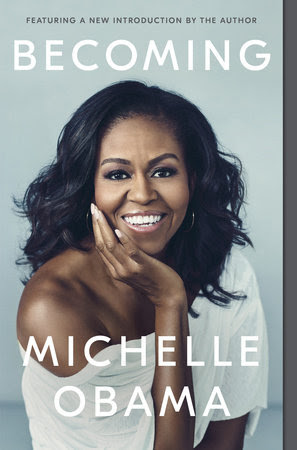
Michelle Obama's autobiography Becoming is turning out warm, readable, and beautifully written. Still reading earlier passages about her childhood piano lessons when she grew up in Chicago, I'm enjoying comparing and contrasting her literary approach to her husband's.

Cover of Becoming
via Penguin Random House

Aside from that, I'll just post a list:

Sholem Aleichem: Menahem Mendel (transl. from Yiddish to German)
Assia Djebar: Femmes d'Alger dans leur appartement
Eliese Colette Goldbach: Rust: A Memoir of Steel and Grit
Brit Bennett: The Vanishing Half
Beatrix Potter: The Complete Tales of Beatrix Potter
Aminatou Sow and Ann Friedman: Big Friendship: How We Keep Each Other Close
... and I have a lengthy 'to be read' list too! The perils of being too absorbed in work, and relying too much on 'comfort reads' to get me through my stretches of angst, are that the books pile up too much.

Sunday, August 15, 2021

August 2021 In Books: What I'm Reading

Earlier this month I finished Jutta Person's Esel, a thin German-language volume of cultural history about donkeys and anthropomorphic interpretations of them by everyone from Roman satirists through Christian theologians to German romantics. My uncle M. gave it to me as a birthday present last year because donkeys are my favourite animals. Now another birthday gift, Paul Auster's 4321, is lined up to read next.

The Nickel Boys by Colson Whitehead, and Nigerian writer Akwaeke Emezi's The Death of Vivek Oji, are also read, and although both were undoubtedly good, I won't write reviews at present because they'd be too half-baked.

Cover of A Hundred Million Years and a Day
via Gallic Books/Belgravia Books

In a big geographical leap, I've moved to reading A Hundred Million Years and a Day, a French hit novel that is set at various times in the first half of the 20th century, It is written from the perspective of a solitary, dry-souled ivory tower paleontologist — written by Jean-Baptiste Andrea and translated sublimely and award-winningly by Sam Taylor. Perhaps because my French literary frame of reference is small, the atmosphere and the setting remind me of Marcel Pagnol and the spare style reminds me of Le grand Meaulnes. It's also well thought out; sometimes time-hopping in books is so tediously confusing that I want to gouge out my eyes, but here the back and forth — as the details are filled in — adds genuine suspense.

***

The book I'm most enthusiastic right now because it makes me happy is Dancing Man: A Broadway Choreographer's Journey by Bob Avian and Tom Santopietro. A basic knowledge of musicals or of mid-20th century film is enough to make its revelations understandable.

The aim of the authors is to tell us exactly what we want to know: each chapter is grouped quite tightly around a specific musical. Fortunately the gossip is generous and not mean-spirited. We hear that Jerome Robbins, a god of sorts among choreographers, was tremendously unpleasant; but we are also told that this was because he was unhappy.

In general Avian (from whose perspective the book is written) and Santopietro express modern views. Avian, in his eighties, makes little attempt to present a great man's (or woman's) sadism as ideal or even as a useful evil. He presents it as a flaw, but as a flaw whose owner still deserves sympathy.

I love the old-fashioned turns of phrase in the book, too, however: 'great gal', or "[... q]uicker than you can say “West Side Story,” Audrey set her cap for Michael and snagged him."

It feels twee or reductive to call Avian delightful, but the adjective comes to mind anyway.

The authors are friendly raconteurs, as we see not just there, but also when they wink at the audience with sentences like this vignette from an unsuccessful play production:

Act Two contained a King Lear ballet—yes, you read that right—and I was completely at sea.

Avian also mentions his experience of 1960s drug culture in a characteristically wholesome way:

I tried pot for the first time and thought, “Hmm, this sure is a lot of fun. And creative.”

He died in January this year, as I was startled to learn when reading his Wikipedia biography.

Readers who want memoirists to disembowel their private lives might find this book not for them, but fans of Broadway, or of 20th century American film star history, and perhaps also fans of New York City's social history in general, will probably love this. National Public Radio included it in their list of the best books of 2020.

*

"Tony award-winning Broadway choreographer Bob Avian dies aged 83" by Adrian Horton (January 22, 2021) [Guardian]

***

As part of my research into the history of the earliest decades of the 20th century, I have also jumped into the World War I chapters of the British philosopher Bertrand Russell's Autobiography. Published well after that War, when the Cold War was still on, it is like the oak in Jean de la Fontaine's fable — not in that its roots touch on the realm of the dead, but rather that its roots touch on the realm of Victoria and an era of absolute British aristocratic privilege that seems utterly absurd now.

I first read the autobiography when I was a teenager struggling with my own opposition to the Afghanistan and Iraq wars. He was briefly an imaginary posthumous mentor.

And now — even as I wince at his views on relationships during the passages about Lady Constance Malleson, Katherine Mansfield and Lady Ottoline Morrell; even as I find him overprivileged in one passage, and mindbogglingly out of touch in another; and even though I don't admire his catty moments — in general it feels like his intelligence, his wonderful turns of phrase, and his dedication are not in doubt. And his insights on political and social celebrities are also great, if partial, gossip.

Cover of Why Men Fight (1917)
via Wikimedia Commons

Here is a passage where he has been imprisoned due to his activism against the First World War, in a rather posh prison division thanks to the intervention of former British prime minister Arthur Balfour:

I found prison in many ways quite agreeable. [...] I wrote a book, Introduction to Mathematical Philosophy [...] and began the work for Analysis of Mind. I was rather interested in my fellow-prisoners, who seemed to me in no way morally inferior to the rest of the population, though they were on the whole slightly below the usual level of intelligence, as was shown by their having been caught.

(Russell, Bertrand. Autobiography. London: Unwin Paperbacks, 1978. p. 256)

*

I'm also reading Hidden Valley Road by Robert Kolker, about a large midcentury American family that included a high number of sons with schizophrenia. I am struggling with it. As a takedown of the conformist 1950s ideal of domestic bliss, or of the unalloyed joys of military service and being in a military family, I think Hidden Valley Road is the most effective.

I would like it better if the family could have written their own history. It's not much fun of reading their lives as a psychological literature exercise. From my amateur armchair perspective, I like it better when we acknowledge that we can follow some of the thought patterns of the more conspicuously mentally ill, for example.

I've known people who are genuinely healthy in mind, like the psychological equivalent of an amazingly athletic person. In most cases I would say, however, that we are participants in, and not observers of, the human battle for logic, reason and proportionate emotional reactions. If we don't acknowledge that, it's unhealthy for ourselves and harmful to others.

Sunday, July 25, 2021

Around the World in 32 Countries: South Africa

"Typically, hair gets done on weekends (Hillbrow, 2010)"
Two women in the Hillbrow neighbourhood of Johannesburg, South Africa.
Attributed to Guinivere Pedro, c. 2015
via Wikimedia Commons, CC-BY-SA 4.0 license


Official languages:

  • English (first language of 9.6%)
  • isiZulu (22.7%)
  • isiXhosa (16%)
  • Afrikaans (13.5%)
  • Sepedi
  • Setswana
  • Sesotho
  • Xitsonga
  • siSwati (Swazi)
  • Tshivenda
  • isiNdebele

Modern-day state formation year: 1994 (democratization)

"Dune Strandveld growing on dunes
in Blaauwberg Nature Reserve. Cape Town."
Photograph taken ca. 2010, attributed to Abu Shawka
via Wikimedia Commons. Public domain.

Capital city: Pretoria (executive), Bloemfontein (judicial), Cape Town (legislative)

Surface area: 1,221,037 km2 (larger than Ethiopia and smaller than Mali or Angola)


Currency: South African rand

Driving side: left


Main trading partners: Germany, the United States, China, Japan, the United Kingdom and Spain

Crops: Sugarcane, maize, grapes, oranges, potatoes, wheat, soy

Mining: Amongst top 10 worldwide producers of platinum, chromium, manganese, titanium, vanadium, iron ore


Sources:

South Africa [Wikipedia]
List of countries and dependencies by area [Wikipedia]
Economy of South Africa [Wikipedia]

***

While the history of South Africa stretches back thousands of years, I concentrated in my reading of South African books on the period from 1900 to the present.

Long Walk to Freedom by Nelson Mandela is a classic that requires little introduction. I am still reading Volume I. He portrays his childhood in a chief's extended family and household in the 1910s and 20s, then his education in colonial British institutions, reaching the apex of his university studies at Fort Hare. Then the life he'd envisioned takes another swing into the unknown as he runs away from his guardian, a short job at a mining complex abruptly breaks off, and he grows into work at a lawyer's office in Johannesburg. There he meets anti-apartheid activists, including Communists, and no longer just attempting to fit into the socioeconomic reality of South Africa as it approaches the Malan years where apartheid became solidified into its extremist nadir, he begins to become political. Altogether he takes pains when setting forth his own life's story to portray the different groups and milieus in South African society, to depict a bonded rather than isolated nation.

Because Albert Luthuli's life ended in the late 1960s, long before the defeat of apartheid, and he was more religious, his book Let My People Go offers the most insight into specific topics: Christianity in South Africa, attempts to bring about reconciliation between groups in the country (South African civilians who were facing apartheid in different parts of the land, urban or rural; the different White political groups and administrators; the interracial 'Coloured' population and population of Indian extraction; Communists and Anglicans and Catholics; racist White individuals and policemen and less racist White individuals and policemen), the creeping influence of apartheid on Luthuli's home ground of education, and initiatives to organize passive resistance on a large scale, in the mid-20th century.

Maloti-Drakensberg Park (Lesotho, South Africa)
by Véronique Dauge, c. 2005
via Wikimedia Commons, courtesy of UNESCO
CC-BY-SA 3.0 license

Apartheid, the volume of anti-apartheid essays edited by the exiled writer Alex La Guma to help concert international pressure to undermine the apartheid government, offers a broader spectrum view of all of South African history up to the early 1970s, when it was published abroad in Britain. It establishes a factual basis earlier in the book of the gradual introduction of racist government policy whether English or Afrikaner, details apartheid's impact in the fields of education, land ownership, military spending and even sports, and winds up with perspectives of the future that admit in some cases that violence and/or Communism may be the answer.

While the essays aren't always thrilling to read, and the earnest interspersed poetry often feels like the offcuts of better work, it remains informative even after 40 years of events have piled on top of the ones in the book. It's also interesting to me even in that bygone era of the Vietnam War, other after-effects of colonial rule, Cold War coups and invasions, etc., South African government policy internationally still had the power to shock.

"City Deep container terminal Johannesburg 2014"
via Wikimedia Commons, CC-BY-SA 4.0 license

Turning to fiction: Lauren Beukes's novel Zoo City, set in her birth city of Johannesburg and published in 2010, gives a fantasy view of present-day South Africa. Her heroine is a young Black woman who had intended to become a journalist but had become sidetracked by the violent death of her brother, drug abuse, and a prison term, into petty crime. Even strangers recognize that she has been in trouble with laws written or unwritten, due to the presence of a large sloth by her side. This particular one appeared after the brother's death and it is linked to her by magic: a pet with a mind of his own, her external conscience, and her partner.

Crime and socioeconomic inequality in fictional Johannesburg are the focus of the novel. But, although this is by no means central, Beukes also mentions how the city (fictionalized in the book, but mirroring in some respects the 'true' South Africa) has paradoxically been a haven of sorts for refugees from violence, specifically wars in the northern African continent. 

To quote Wikipedia:

The UN High Commissioner for Refugees in 2008 reported over 200,000 refugees applied for asylum in South Africa, almost four times as many as the year before. These people were mainly from Zimbabwe, though many also come from Burundi, Democratic Republic of the Congo, Rwanda, Eritrea, Ethiopia and Somalia. Competition over jobs, business opportunities, public services and housing has led to tension between refugees and host communities.

The author also spent time studying in New York City. Her depiction of urban crime seems like it can be applied beyond Johannesburg, perhaps as a result of that, even if it's true that in smaller cities like Berlin I do expect violent crime but not regular shootouts. What I did find refreshing is that, although for example the imaginary musical scene in her book is influenced by American pop culture, she helps make pretty clear through her descriptions that the world doesn't revolve around the US or Europe (as I'm sometimes tempted to think from my German-Canadian perspective). Most of the preoccupations, entertainment and future of South Africa are driven from within.

Beukes's writing style in Zoo City is prone to clichés and the narrator indulges in libertarian-esque cynicism that I unkindly found performative. First-person, present-tense narration is not everyone's favourite quirk, either, even if it is fashionable. But her strong characterization, scene-setting and writerly intensity made me forget and overlook these aspects, and the novel was compelling to read to the end.

Sunday, June 27, 2021

July 2021 In Books: What I'll Be Reading Next

In the 'journey around the world' in books, I'm wrapping up my sojourn in South Africa: Zoo City by Lauren Beukes, the essays in Apartheid collected by Alex La Guma, and Albert Luthuli's Let My People Go all being read, I only still need to finish the first volume of Nelson Mandela's Long Walk to Freedom. (I've reached the stage of that autobiography where, as a fledgling lawyer trying to fit into his professional sphere without making waves, Mandela still decides to become politically active, joining meetings with Communists and other groups who are striving to end apartheid.)

South Korea is next. Kim Jiyoung, Born 1982 felt so cheerless at the first reading that I've decided not to reread it. The opening pages of Kyung Sook-Shin's historical tale The Court Dancer — about a Korean courtesan who marries a French nobleman — were good, but I wanted something different. Aside from Korean folktales available in online book archives in a colonial-era English translation, it looked like there were mostly books about North Korea or about 'comfort women' during the Second World War or other depressing books to choose from in my online book subscription website. And perhaps South Korean manhwa is a more promising genre for lighthearted topics than literary fiction.

In the end, I chose One Spoon On This Earth in an excellent translation — stylistically speaking, at least; of course it would require a detailed knowledge of Korean to know about the technical accuracy. It is written by Ki-young Hyun, and fictionalizes — during the early chapters, at least — a childhood during the post-WWII occupation of Korea. The tyranny of Japan and the war itself were history; but starvation, a cholera epidemic, the destructive effects of post-traumatic stress disorder on home life, a tug-of-war between the occupying authorities (American and Korean) and the Koreans themselves, and battles over Communism, partition, and independence ensued.

Likely the list of 'trigger warnings'  for this book is long enough to be a small book in itself.

*

It has been hard to find Ukrainian books to read after the South Korean books are done. For example, Joseph Roth may have been born in the Ukrainian portion of Galicia, but to me it seems highly unlikely he'd have considered himself Ukrainian. Nikolai Gogol's books also feel like an ambiguous case. Let's see.

But if I step back and revisit countries with under 60,000,000 inhabitants:

A French colleague of mine with Algerian family members has suggested Algerian books to read — she also offered to read Les Misérables by Victor Hugo with me in tandem.

I might also finally track down a copy of the book by a Taiwanese author that another colleague's wife recommended to me a year ago: The Silver Bicycle.

*

Yesterday I cycled to Dussmann Kulturkaufhaus, on a dozy summer weekend afternoon with remarkably few tourists roaming the Friedrichstraße, and browsed in comfort in the English-language books department. In the end I emerged with two novels — Brit Bennett's The Vanishing Half and Imbolo Mbue's Behold the Dreamers — and a travel memoir-cookbook — Ripe Figs by Yasmin Khan.

Lastly, my to-be-read pile still includes the 'best of 2020' books and related books from the National Public Radio list. Five hours are left of the Stamped From the Beginning audiobook, and I've made a little progress in Hidden Valley Road by Robert Kolker.

Cover of Ripe Figs,
via Bloomsbury Publishing


Friday, May 07, 2021

April 2021 in Books: What I've Been Reading (Children's and Youth Literature)

In the course of a deep dive into the Edwardian Age, I launched back into Beatrix Potter in April.

The Tale of Peter Rabbit (1902), of course, is a classic and led to the breakout success of the author, when publisher Frederick Warne — wiser than other publishers who had rejected her — asked for the manuscript to be illustrated in colour and accepted it on those terms:

Source: PenguinRandomHouse

The Tale of Squirrel Nutkin: A young squirrel, bristling with energy, goes on short boat trips together with other squirrels to an island in the English countryside. The others, who respect the chief inhabitant of the territory, bring tribute to the elderly owl who inhabits the island, before they roam around it. But Squirrel Nutkin badgers the owl, taunting him with flippant rhymes, as the threat that the owl will finally take his revenge intensifies. I have to confess I didn't particularly like this book.

It is a cannibalistic book, in a way. In the Narnia books the conundrum of humanizing animals, but still making them attack or eat each other, also arises; but I think C.S. Lewis took more steps to address the paradox. One assumes that in the Edwardian Age, children were not thought to be particularly sensitive.

Source: PenguinRandomHouse

And The Tailor of Gloucester shows off Potter's range of illustrator skill with watercolour paintings: they teem with 18th century formality, panache and detail. It was, apparently, the author's own favourite work and is based on a local legend not unlike the Heinzelmännchen of German fairy tales.

Source: PenguinRandomHouse

***

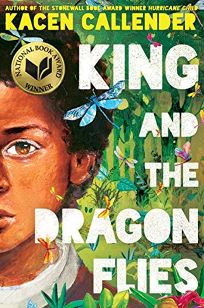
King and the Dragonflies is a middle grade or young adult book that was published in 2020 and landed in National Public Radio's best books of the year list. Kacen Callender also wrote Felix Ever After, which follows a transgender teen and, getting a lot of attention when it came out, feels like a pioneering book in the broadening social awareness of transgenderism, non-binary ideas of gender, etc.

via Publishers Weekly

The narrator protagonist of King and the Dragonflies is a teenager who lives in rural Florida, in walking distance of the wilderness of the bayou. Hurricane Katrina's legacy still looms large, and based on the ages and birthdates it is clear that the plot is supposed to be set in the here and now. The bayou itself mostly suggests, to the protagonist, his brother Khalid — an older, only sibling who died unexpectedly as a school athlete, and whose spirit King likes to think is reincarnated in the dragonflies that fly over its surface.

His parents are torn up about the sudden loss of their son, also uneasy and angry in a social environment where the sheriff is a racist and they feel unsafe.

King and the Dragonflies has old-fashioned elements: the benign and not-so-benign rednecks who appear in the periphery of King's life are not too far off from the 1930s Alabama of To Kill a Mockingbird.  This (possible) literary continuity says more about how engrained racist thought processes become in the mass psyche once they enter it, however, than about the author's intentions, I imagine. [A line of thought suggested also by Ibram X. Kendi's historical book Stamped from the Beginning, which shows in hundreds of ways how racist tropes and practices that we consider as part of the social landscape now, and don't always question and fix as much as we should, were introduced over the course of colonialist history, were certainly 'not always there,' and have unfortunately been very difficult to de-introduce.] 

Racism and homophobia are shown as parallel ills, the battle against them both necessary for equality and individual freedom in the present day. Callender (the author prefers the pronouns they/them) also specifically stress intersectionality. People who champion the one cause might reject the other cause — in the book, King's father is homophobic, and King's friend Sandy, who is White and gay, is struggling to recognize his own family's racist legacy even if he does not share their prejudice. We can't fix one problem and believe that everything is fixed; the problems are interconnected and, to very crudely paraphrase Martin Luther King Jr., we can only enjoy justice for the one once we have ensured that it exists for all.

*

For the target audience: I think this book is a friendly companion to gay (or bisexual) children/teenagers, and an encouragement to come out of their shell, trusting in their own individual truth and worth. And to straight classmates it is a great encouragement to be a braver and more reliable ally.


***

Kacen Callender [Wikipedia]


Sunday, February 07, 2021

February 2021 In Books: What I'll Be Reading Next

For the Around the World series, I am still finishing the reading from South African writers.

Apartheid: A Collection of Writings on South African Racism by South Africans, edited by Alex La Guma, is of course the book with which I started the reading.

Its essays, by expatriates who are far-flung in Europe due to their opposition to the apartheid government, lay out the racial political, economic and cultural structure of apartheid by the time the book was published. (Ironically perhaps, given colonial history, the book was published in London, 1972.) Land allocations, education, defence spending, the entire history of the colonization of South Africa are knowledgeably sketched... I think the interspersed poems, pan-African themes and all, are meant as seeds for a free post-apartheid culture.
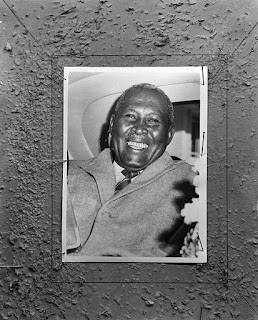
Albert Loethoeli, leider Zoeloes in Zuid-Afrika (1967)
(Albert Luthuli, leader of the Zulus in South Africa)
From the Nationaal Archief, Netherlands
via Wikimedia Commons

Long Walk to Freedom (Vol. 1) by Nelson Mandela and Let My People Go by Albert Luthuli offer two perspectives on the fight against apartheid. Mandela (a member of the Xhosa people) came from a more prestigious background, and also appeared to benefit by the pre-apartheid reality more, and has more rigour and skepticism and lordliness. Luthuli (a member of the Zulu people) came from a less prestigious background, working as a teacher in what he describes as a cloistered academic environment for well over a decade before becoming a less well-paid chief; he also embraced Christian precepts to an extent that makes him feel more idealistic and gentle-tempered —most of the time. Like my paternal grandfather, one can sense bedrock underneath his mild willingness to find out what other people want and to let them have their way. Both Luthuli and Mandela, of course, became Nobel Peace Prize laureates.

A South African colleague, when I asked him, conceded that I could theoretically look into many classics of South African literature (Nadine Gordimer's work and Alan Paton's amongst them). But he suggested skipping them — instead, exploring contemporary South Africa and urban crime through the lens of Zoo City by Lauren Beukes. I'm still hoping to come across an ebook version; but, failing that, the audiobook is an option.

*

As an accidentally companionable read, I am also reading more of Ngũgĩ wa Thiong'o's non-fiction and criticism. Although his personal experience of colonialism and neocolonialism centres on Kenya, he alludes in the particular works I'm reading to the South African apartheid state — not yet dismantled at the time he was writing. Apartheid would only crumble in 1994. There's also a tragic element in the knowledge as a reader from the future, of the impending bloodshed in Rwanda.

I've become impatient with the rote Communist passages — I can only read 'join hands with the proletariat' or 'comprador classes' so many times, without feeling that these phrases lose all meaning — in these essays/speeches. And I suspect that he turned into a self-conscious Hero of the Lecture Hall type of academic in his later years (I say as a disgruntled former undergraduate). But Moving the Centre: The Struggle for Cultural Freedoms is fascinating as a geopolitical time capsule of the 80s and 90s.

I do feel awkward when Ngũgĩ wa Thiong'o writes of the need to write in African languages, not English or French or Portuguese, and he celebrates writing works in Gikuyu. In the end I am reading his celebration of writing in Gikuyu in English, because that is accessible to me.

His writing in Moving the Centre is less raw than the writing in his prison memoir Devil on a Cross, but the mood remains invigorating. He is always resisting.

To know a language in the context of its culture is a tribute to the people to whom it belongs, and that is good. What has, for us from the former colonies, twisted the natural relation to languages, both our own and those of other peoples, is that the languages of Europe [...] were taught as if they were our own languages, as if Africa had no tongues except those brought there by imperialism [...]

and

'A peaceful country, don't you think', he [a colonial farmer] would say turning to the house servants who stood by ready to serve him his breakfast. And the house servants would also stand on some of the bodies but at a respectful distance from the master and they would chorus back: 'Yes master, peace'.  

***

Stamped from the Beginning by Ibram X. Kendi is proving challenging and rewarding, an indispensable and amazingly researched completion of any picture of European and American politics from the Renaissance onwards, and a gem to any history enthusiast who is genuinely curious. A few passages are horrible to read, like the fate of Sarah Baartman, the 'Hottentot Venus,' who was treated essentially as a laboratory rat by scientists of the late Enlightenment and early Napoleonic era.

*

In British contemporary literature, I started listening to Summer by Ali Smith.

It is a stream-of-consciousness third-person-narrative novel from 2020, of the musings of an English teenager on political news as she grapples with homework, her parents' separation and her brother's predicament.

The book is well-written and critically acclaimed.

It is also very 'of the moment' as it talks about everything from the deported British residents of the Windrush Generation through Trumpism to Australian wildfires. But I don't like remembering the times where I 'burned at the stake' of world politics as much as the teenager in this book. To be fair, likely the author's own angst derives from Brexit, which is generally not felt as the deep crisis of economics, politics and social culture, the daily emotional torment, in Germany that it is felt to be in the UK itself. But at least I walked in protests against the War on Iraq instead of just complaining at home.

That feeling of not wanting to read hundreds of pages of aimless whining, however literary and however near my own political orientation, was why I did not finish the book.

Cover of Summer, via Penguin Books UK

(The narrator of Summer's audiobook struggles with the repetitive 'he said' and 'she said' that dot the dialogue. This dialogue, in its faster rhythm, does bring movement and pace to the book. Therefore I found myself wishing that Ali Smith had written a play instead.)

*

In preparation for Canada Reads 2021, the televised competition will broadcast starting March 8th on CBC, I have begun reading Butter Honey Pig Bread by Francesca Ekwuyasi. Magical realism a little along the lines of Toni Morrison, it begins by telling the tale of the childhood of a spirit that tends to slip away from the living world.

(Content warning: There's menstrual blood in an early chapter, so the easily shocked should likely find a more soothing book to read; and also serious subject matter like stillbirths etc.)

Cover of Butter Honey Pig Bread, via Arsenal Pulp Press

It's not self-consciously literary — you never feel like the word choice is stiltedly signposting its own excellence, even while it is excellent — nor pretentiously enigmatic.

*

Buck Naked Kitchen has a risqué title, but it's a respectable Canadian cookbook, published last year by Kirsten Buck. It has become a favourite of mine to the degree that I am sprinkling around good reviews around the internet.

I don't follow the Whole 30 Diet, which is a main nutritional inspiration for the book. But it's easy to stick to the more permissive recipe variants.

My family favourably reviewed the Smashed Potatoes with Roasted Red Pepper Sauce when I baked them the day before yesterday, as well as the pepper maple syrup bacon, so these appeal even to traditional tastes. I also liked the more consciously healthy or 'new-fangled' recipes. The Creamy Cashew Milk was frothy and sweet. The Perfectly Cooked Wild Rice was well cooked as promised: nutty and lightly salty and nicely grainy without being hard. And I've been making Buck's variation of a Fruit and Nut Trail Mix — walnuts, cashews, coconut flakes, hazelnuts, sunflower seeds, pumpkin seeds, dried goji berries and blueberries and white mulberries — for my brothers. It's filling and has a nice balance of natural sugars and colours.

The cookbook's healthy ingredients (well, all right, I guess the bacon is debatable as a healthy ingredient), when mingled imaginatively, can have an experimental flair while being as satisfying as steak and potatoes.

The author of Buck Naked Kitchen,
via Penguin Books Canada

It was also pleasant to see the peaceful photography: daytime lighting and a leitmotif of green plant life.

The idea for soup-to-go came to me while on a fall hike in the Whiteshell Provincial Park, located in southeast region of Manitoba along the Ontario border. The wind coming off the water was cold enough to give me a chill. Instead of the energy bar I packed, I really just wanted something to warm me up. 

Earlier in the week I had made the saffron rice from Yotam Ottolenghi's and Sami Tamimi's 2012 Jerusalem cookbook. It turns out that I dislike the flavour of saffron, even if the barberries were tasty. But I also undercooked the rice — not the recipe's fault, I am certain, because I used brown basmati rice instead of white basmati rice. The dill and white pepper instead of black pepper are important to the flavour, blending into and softening the stern flavour of the saffron, and I was impressed that the authors had figured this out.

Cover of 100 Cookies, via Chronicle Books

Lastly, I've begun baking recipes from Sarah Kieffer's 100 Cookies, an American bestseller in 2020, beginning with the soft chocolate chip cookies recipe. It is as regimented as Buck Naked Kitchen is flexible. Before the recipes begin, there are firm instructions, rather than idyllic word-paintings of kitchen escapism.

While Ottolenghi can be precise enough and I've grumbled in my head about the fiddly gram measurements and the need to measure fractions of a centimetre, it was only with 100 Cookies that I felt like I was baking with a fastidious superego looking over my shoulder.

But my family, of course, just experienced the final result. They made blissful, Cookie Monster-like gestures as they ate the doughy, freshly baked cookies with the chocolate melted and gooey in them.

So, in the end, weighing out each 45-gram sphere was worth it.

*

Aside from Buck Naked Kitchen, Barack Obama's A Promised Land has become a 'comfort read.' Since I followed the news so much during the 2008 financial crisis, etc., the book is illuminating the past, as well as setting a 'prologue' for the not-identical-but-similar challenges of the Biden Administration. Besides, it calms my anxiety when turmoil arises in the workplace.

Saturday, January 23, 2021

Around the World in 32 Countries: Colombia

Number of recognized regional languages: 68
Main languages: Spanish, (in the archipelago of San Andrés, Providencia and Santa Catalina) English

Independence: 1810 (declared from Spain)

Colombia and Panama (and, for a while, even more states) used to be joined as the Republic of New Granada, the Granadine Confederation, and then the United States of Colombia, in the 19th century.

"[... T]he Republic of Colombia was finally declared in 1886. Panama seceded in 1903, leading to Colombia's present borders."

Laguna de la Cocha (El Encano)
Photograph by G. Parra (attr.), c. 2013
via Wikimedia Commons, CC-BY-SA-3.0 licence

Capital City: Bogotá

Surface area: 1,141,748 km2 (larger than Bolivia, smaller than Peru)

Currency: peso
Driving side: right

Main trading partners: United States, China, EU, Latin American countries

Main exports that are food: fruit and other produce, sugar and sweets
Main exports that are not food: mineral fuel, oils, plastics, precious stones, metals, lumber, electronics, clothing, glass, etc.

Information taken from "Colombia" and "List of countries and dependencies by area" [Wikipedia]

***

For Colombia, I read two books.

A Hundred Years of Solitude requires little introduction! Of course it made Gabriel García Marquez one of the giants of world literature. I did not finish it because I objected to some of the content, but it is undoubtedly great literature and an absorbing world to sink into.

It is an epic of multiple generations who begin a backwoods life in the remote forests of Colombia and found a town. Their community is visited by itinerant eccentrics who pierce it, they see the fading traces of the conquistadores of long ago, and disperse at times amongst the men who (for whichever reason) linked up to civilization again by signing up to fight in its wars.

Rocas del abra Zipaquirá
- Landscape in the Zipaquirá archaeological zone, Colombia
Photograph by S. Iizarazo, c. 2012
via Wikimedia Commons, CC-BY-SA-3.0 licence

Because Marquez's genre here is magical realism, magic rules his characters' existence, whether it is the magic of science or the magic of alchemy.

The descriptions of rural life are not the elite explorations of national history and culture that often characterize 19th century literature to which one is used. The choice of milieu, characters and themes feel symptomatic of the author's leftwing sympathies. There is a distrust of the faraway centres of national authority, which filters through to the attitudes of the characters.

The reason I stopped reading it is that an adult male character becomes infatuated with a 9-year-old girl; even the character recognizes that this is weird, but either way I thought 'I'm out of here.'

Pendants by the lost Tairona people
In the Metropolitan Museum of Art, NYC. Photo by R. Müller (2006)
via Wikimedia Commons, CC-BY-SA-3.0 licence

*

La Casa de la Belleza was written decades later, first published in 2015.

It transplants us to modern times in urban contemporary Colombia. Written by a journalist, Melba Escobar de Nogales, it explores Bogotá (a city of over 7 million people — more than Berlin's population) through the lens of a set of women who frequent the eponymous beauty salon. It looks pessimistically at gender relations, class, and racism, and the imperfections of the privileged class. Women and everyone else exploit others as they are exploited themselves. Not unexpectedly, since Colombia is still over 70% Roman Catholic, the book also casts a jaded eye on the rampant violence and moral corruption amongst the purported Christianity of the elite.

Of course the author's theme is the ridiculous juxtaposition of a society's obsession with beauty and material luxury, with the perpetration of ugliness and degradation.

The novel itself was a quick success internationally, translated into multiple languages from the original Spanish. I read it in Spanish and found the vocabulary quite specialized in parts; but now I know what sancocho, avena and aguardiente are.

Escobar writes this passage in La Casa de la Belleza

"Al ponerse en rojo, mendigos, desplazados, forajidos, drogadictos, tullidos, saltimbanquis, desempleados, analfabetas, maltratados, mutilados, niños y mujeres preñadas asaltan los vehículos en un performance diario tan repetitivo y predecible que ya a nadie sorprende. O a casi nadie."

(Rough translation: When the traffic lights turn red, beggars, displaced, outlaws, drug addicts, cripples*, charlatans, the unemployed, illiterate, and maltreated, children and pregnant women attack the cars in a daily performance so repetitive and predictable that no one is surprised any more. Or almost no one. [*I'm using this term as it appears to be the closest translation, but I am not sure if it is appropriate to use it in English.])

Karen is the heroine. She grew up in the seaside city of Cartagena as the daughter of a teen mother in the slums, or the barrio. A single mother, saving tips from her work in the Bogotá beauty salon to pay for a better life for her son, dark-skinned and attractive, her warm heart and capacity to care for others are badly repaid with betrayal and rape. A whole network of characters who all know each other begins having a noxious effect on her life. Eventually she becomes an ambiguous figure herself — or does she?

I think this book is a thriller rather than an elaborate literary novel, and it is also frankly just grim to read; I couldn't wait to have it over with and would only recommend it to someone who is neutral-about to fond-of reading about murder and violence against women. It treats its characters too strictly to gather the scope or insight of great literature.

I speak from little relevant experience, but my impression is that the book also splits and founders on a central paradox. It presents itself as critical, fearless and progressive. But the narrative voice complains about minor fishes, never landing real hits on the power figures who bear the most responsibility for the social/political/economic problems that face Colombia. Although she does try to portray individual members as pathetic and frail. In the end it feels more passive-aggressive than iconoclastic.

The book also 'borrows' grievances from Afro-Colombian women — the whole spectrum of racism from the daily torments of straightening hair to look 'respectable,' up to the more violent manifestations — when it might be better to read a book by Afro-Colombian women about this phenomenon instead.

(At the end, I'll note as a disclaimer that a Colombian woman, perhaps in her 30s, was once invited into my high school Spanish class in around 2001 — she was the friend of my teacher. She stressed that many people around the world had a totally wrong view of Colombia: it is not all drug lords and warfare.)

El Salto de Tequendama
Photograph by J. Cufiño (attributed.), c. 2013
via Wikimedia Commons, CC-BY-SA-4.0 licence