Tuesday, September 16, 2008

Crossing the Bar

Today I want to pay tribute to David Foster Wallace, an American writer and professor who died, only 46 years old, last Friday. Before his death, the only writing of his that I'd read is the address that he gave at the commencement ceremony of Kenyon College in 2005, but it immediately interested me in his work. The address very much impressed me, not so much even for its wittiness or the fluency of expression, as for the empathy and the thought that had gone into it, and his refusal to retread the platitudes, or to present any idea or statement that he had not questioned and weighed beforehand. This morning I also went to the website of Harper's Magazine, to which he had contributed eleven articles since 1989. As it has been highly recommended, I read his account of a cruise ship journey, "A Supposedly Fun Thing I'll Never Do Again" (originally published as "Shipping Out"), which is really brilliant in its conciseness and detail and sharp insight.

"Shipping Out" is specifically the tale of a cruise in the Caribbean, which is intended to be a luxurious, stress-free zone but is in a way very stressful, especially if one's skepticism creates a friction with the micromanaging hierarchy and the "philosophy" that pervades the whole. Roald Dahl's stories, like his book The Witches and the tale "The Boys Who Talked with Animals" come to mind, as they similarly depict the unhealthy bubble of the wealthy lifestyle, and the truly obnoxious and solipsist behaviour which they encourage. In any case, the minutiae of the voyage, and Mr. Wallace's reactions to them, are so vividly rendered that it is hard not to feel in the end as if one had undergone the cruise one's self. And it is often extremely funny.

The Kenyon commencement address concerns itself, firstly, with the question of what the real value of a liberal education is intended to be. Mr. Wallace relates this problem to that of the reality that will meet the students after they go out into the world. Here he is conspicuously free of idealism. He speaks of the future largely as a grinding routine, in which one can choose to remain lazily absorbed in one's own self-centered perspective, interpreting and classifying the world as being either convenient or inconvenient to one's self, without any thought or perception beyond that. If there is any value in a liberal education, it is in instilling the ability to rise above this indolent "default setting" and to choose to explore and understand the reality beyond it, without being intellectually and emotionally fettered by egotism. Here are long excerpts (I am posting them on the assumption that the speech is not copyrighted; if it is, I'll take them down again):
[L]et's say it's an average adult day, and you get up in the morning, go to your challenging, white-collar, college-graduate job, and you work hard for eight or ten hours, and at the end of the day you're tired and somewhat stressed and all you want is to go home and have a good supper and maybe unwind for an hour, and then hit the sack early because, of course, you have to get up the next day and do it all again. But then you remember there's no food at home. You haven't had time to shop this week because of your challenging job, and so now after work you have to get in your car and drive to the supermarket. It's the end of the work day and the traffic is apt to be: very bad. So getting to the store takes way longer than it should, and when you finally get there, the supermarket is very crowded, because of course it's the time of day when all the other people with jobs also try to squeeze in some grocery shopping. And the store is hideously lit and infused with soul-killing muzak or corporate pop and it's pretty much the last place you want to be but you can't just get in and quickly out; you have to wander all over the huge, over-lit store's confusing aisles to find the stuff you want and you have to maneuver your junky cart through all these other tired, hurried people with carts (et cetera, et cetera, cutting stuff out because this is a long ceremony) and eventually you get all your supper supplies, except now it turns out there aren't enough check-out lanes open even though it's the end-of-the-day rush. So the checkout line is incredibly long, which is stupid and infuriating. But you can't take your frustration out on the frantic lady working the register, who is overworked at a job whose daily tedium and meaninglessness surpasses the imagination of any of us here at a prestigious college.

But anyway, you finally get to the checkout line's front, and you pay for your food, and you get told to "Have a nice day" in a voice that is the absolute voice of death. Then you have to take your creepy, flimsy, plastic bags of groceries in your cart with the one crazy wheel that pulls maddeningly to the left, all the way out through the crowded, bumpy, littery parking lot, and then you have to drive all the way home through slow, heavy, SUV-intensive, rush-hour traffic, et cetera et cetera.

Everyone here has done this, of course. But it hasn't yet been part of you graduates' actual life routine, day after week after month after year.

But it will be. And many more dreary, annoying, seemingly meaningless routines besides. But that is not the point. The point is that petty, frustrating crap like this is exactly where the work of choosing is gonna come in. Because the traffic jams and crowded aisles and long checkout lines give me time to think, and if I don't make a conscious decision about how to think and what to pay attention to, I'm gonna be pissed and miserable every time I have to shop. Because my natural default setting is the certainty that situations like this are really all about me. About MY hungriness and MY fatigue and MY desire to just get home, and it's going to seem for all the world like everybody else is just in my way. And who are all these people in my way? And look at how repulsive most of them are, and how stupid and cow-like and dead-eyed and nonhuman they seem in the checkout line, or at how annoying and rude it is that people are talking loudly on cell phones in the middle of the line. And look at how deeply and personally unfair this is.

[. . .]
It is my natural default setting. It's the automatic way that I experience the boring, frustrating, crowded parts of adult life when I'm operating on the automatic, unconscious belief that I am the center of the world, and that my immediate needs and feelings are what should determine the world's priorities.

The thing is that, of course, there are totally different ways to think about these kinds of situations. In this traffic, all these vehicles stopped and idling in my way, it's not impossible that some of these people in SUV's have been in horrible auto accidents in the past, and now find driving so terrifying that their therapist has all but ordered them to get a huge, heavy SUV so they can feel safe enough to drive. Or that the Hummer that just cut me off is maybe being driven by a father whose little child is hurt or sick in the seat next to him, and he's trying to get this kid to the hospital, and he's in a bigger, more legitimate hurry than I am: it is actually I who am in HIS way.

Or I can choose to force myself to consider the likelihood that everyone else in the supermarket's checkout line is just as bored and frustrated as I am, and that some of these people probably have harder, more tedious and painful lives than I do.

[. . .]
The really important kind of freedom involves attention and awareness and discipline, and being able truly to care about other people and to sacrifice for them over and over in myriad petty, unsexy ways every day.

That is real freedom. That is being educated, and understanding how to think. The alternative is unconsciousness, the default setting, the rat race, the constant gnawing sense of having had, and lost, some infinite thing.

[. . ]

[A] real education [. . .] has almost nothing to do with knowledge, and everything to do with simple awareness; awareness of what is so real and essential, so hidden in plain sight all around us, all the time [. . .]

It is unimaginably hard to do this, to stay conscious and alive in the adult world day in and day out. Which means yet another grand cliché turns out to be true: your education really IS the job of a lifetime. And it commences: now.


* * *

What is peculiar is that, in both of these works, suicide is mentioned. On one of the previous voyages of the cruise ship, a young man had committed suicide by jumping overboard. And, in the commencement address, Mr. Wallace said,
Think of the old cliché about quote the mind being an excellent servant but a terrible master.

This, like many clichés, so lame and unexciting on the surface, actually expresses a great and terrible truth. It is not the least bit coincidental that adults who commit suicide with firearms almost always shoot themselves in: the head. They shoot the terrible master. And the truth is that most of these suicides are actually dead long before they pull the trigger.

The reason why this is peculiar is that Mr. Wallace himself died by suicide, but in another way it is not peculiar, as it seems that he had already been contending against depression for some two decades. What puzzles me is why someone who did find so much in his surroundings to interest him, and who did have so much sympathy for others, did not find something in those feelings to keep him in the world for a longer time. But given how draining it is to overcome suicidal feelings, and how they do return over and over when one is at one's weakest, it is, I think, no small achievement that he stayed with us as long as he did.

2005 Kenyon College Commencement Address
Harper's Magazine (Links to David Foster Wallace's articles)
An interview with David Foster Wallace (Charlie Rose, 1997; the video, which is 56 minutes long, does take a while to upload, and be careful that it doesn't crash your browser.)
"Foster Wallace is a huge loss," Guardian
Obituary, New York Times

Sunday, September 14, 2008

First Nations and an Imperfect World

Growing up in Victoria, I was exposed a lot to Native American culture and history, in school and elsewhere. Never mind that the art often came in the form of tourist souvenirs; at least my family twice had the privilege of watching bona fide totem poles being carved, and, once, of sitting and listening to a drumming circle at the shore of Elk Lake

It is customary in leftist events (especially demonstrations) – which tend to celebrate e.g. saving the rainforest through decriminalizing marijuana and joining the European Union and stopping discrimination against women to pacifism – to mention that said event is taking place on Coast Salish territory. Certainly not all encounters are prejudicial. There is undoubtedly, however, a widespread stereotype that natives are lazy, alcoholic, and petty criminals, which a handful of classmates repeated without being challenged.

At any rate, as for the natural history of First Nations and their interactions with the temperate rainforest in British Columbia down all the way to Oregon, though it is rather a botanical than anthropological work — a helpful text is Plants of Coastal British Columbia (Lone Pine, 1994), by Jim Pojar and Andy MacKinnon. It is principally intended as a field guide, to help the botany enthusiast identify the plants he encounters on his rambles. There is a fair range of diverse detail, though, and I am quite satisfied with its plentiful images of the plants to help identify them in the wild, as well as with the paragraphs that verbally list the manifold uses of plants like the cedar tree or tule (a type of rush that grows in watery ground, for instance).

Anyway, what principally interested me here, given the context of Sunday and religion, are the native creation myths. There is not one overarching myth. Around Victoria, the major groups are the Coast Salish, the Nootka (a.k.a. Nuu-chah-nulth) and, to the north, the Kwakiutl (a.k.a. Kwakwaka'wakw), though the Haida (a.k.a. xaa.aadaa 7laaisiss, but "Haida" is fine for most mortals) from the Queen Charlotte Islands are also prominent. Not only are the myths and legends of these tribes diverse; there are, of course, still greater differences between their beliefs and those of the Native Americans in the prairies and the East. What I like about the Pacific Northwest Coast myths is that they are not humourless, and that they, far from painting the world in black and white, recognize psychological complexities. The spirit-figures in them (e.g. the Raven) have the moral ambiguity, and the capriciousness, which also characterize the gods of ancient Greece.

The tome of native legends, which I thought we had in our apartment, we either don't have, or it is temporarily hidden among the thousands of other books. Fortunately, my grandfather mentions Tlingit tales (the Tlingit being a people which inhabits the general vicinity of the Alaskan panhandle) in his unpublished memoirs,* as these tales were recounted in Raven, by Dale Burlison De Armond (Anchorage: Alaska Northwest, 1975).
In the first story, it is told how Raven created the world from earth and stones. The world that he created did not please the Raven; it was not the way he had envisioned it. So he destroyed it and formed another world, which he didn't like either. After further efforts, he gave up trying to create a perfect world. He said, "To hell with it!" and left the world imperfect – and so it has remained. [ . . . ]

In further stories, the Raven brings light, water and fire to the earth, and sets the sun in the firmament. This was after a flood, which he had caused himself, out of curiosity; for though he may be an intelligent, clever and wise bird with an enchanting voice, whose sounds are characteristic in southwestern Alaska, he is also a rogue, who likes to do mischief.

As all the people had died in the flood, or he had turned them into stone, he created new people out of leaves. That is why many people die in autumn, when the leaves fall from the trees.
* Erinnerungen: "Ein Traum ist das Leben" (German-English translation by me)


Native Americans of the Pacific Northwest (Introduction to excellently detailed series of essays)
Flickr Photos (Kwakiutl, Coast Salish, Haida)

Plants of Coastal British Columbia (Publisher's information on book)

Tlingit Myths and Texts (Myths as stiltedly recorded in 1904 by John R. Swanton)
Seeking Native American Spirituality (Amusingly but justly irate warning against quack spirituality)
Society-Tlingit (Short essay on the Tlingit)

[N.B. Edited November 2, 2014.]

Friday, September 12, 2008

Interlude

In honour of Andrew Motion's decision to withdraw from his lifelong appointment as Poet Laureate of the United Kingdom, as it was sucking the writerly inspiration out of him and the Queen would not give an opinion on his work, I have written the following verse:

Andrew Motion succeeded Ted Hughes
In the tenured pursuit of the Muse.
(Don't know why) he expected
To be read and redacted
By the Queen, who has much else to do.

So the Laureate would churn out his verse
For anniversaries, birthdays, and worse,
While the Queen petted corgis
And held hat-shopping orgies
And did what all monarchs should do.

Inspiration gave way to despair
And the Poet, deplucking his hair,
Said, "Enough! I won't take it
I'll no longer fake it
There are way better things I'll go do."

And the Queen in her secret retreat
At the rum little pub down the street
Wrote a victory sonnet;
The host, stumbling on it,
Cried, "So the next Laureate is — you!"

Wednesday, September 10, 2008

In Propria Persona


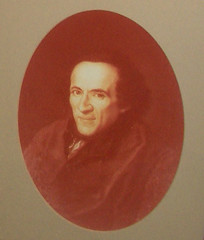
Upon revisiting my sister's Flickr account, I find that she has photographed and uploaded a portrait of Moses Mendelssohn — who, as previously mentioned, was an inspiration for Nathan der Weise — that hangs in our living room. I like this portrait because it is more open and human than others, and in it the philosopher also bears a great resemblance to my grandfather (and, to a lesser degree, his descendant Felix). It is hard to read facial expressions in pictures, as they do seem to subtly change depending on one's frame of mind. At present I find that his gaze is quite direct and engaging, if reserved, and that he has a genial quirk about the mouth. The ascetic lines of his cheek and temple are in abeyance, and yet his sternness remains. So . . . who knows whether this helps bring to life the character in the play, but as my treatment of that work is so unwontedly expansive in any case, this portrait will hopefully round it out.

Sunday, September 07, 2008

Sunday: The Parable of the Rings

The central message of Lessing's Nathan der Weise is embodied by the famous Parable, which Nathan recounts to Saladin, who has asked him which is the true religion. In summary:
A man of the east possesses an opal ring whose quality it is to make the bearer agreeable to God and to man. This ring is passed down to his most dearly beloved son, independent of order of birth, etc., and so on down the generations. Eventually there is a father who loves all three of his sons equally, and has promised his ring to all three of them. So he asks an artist to make two identical rings. Then, when he is on his deathbed, he gives each of them a ring and a blessing, and then dies. Afterward his sons squabble over who received the true ring, but it is never discovered.
But this tale is not without holes in its logic. In some indignation, Saladin asks Nathan whether this is the answer to his question, and Nathan humbly replies, "Shall I ask forgiveness if I do not trust myself to choose among the rings, which our Father made in the intention that they bear no difference?" Saladin counters that the religions are different, so much so that even the food and drink diverge. But, says Nathan, the origins of these religions are the same, and these religions are histories that all describe the same thing. He then explains why he chooses to be Jewish if other religions are equally valid. The traditions of Judaism have been transmitted to him by his parents, and is it not natural that we would prefer, and trust in, a history that has been recounted to us by persons who have proven over and over again that they love us, and that they would not lie to us?

Another flaw is that all three of the sons are behaving quite disagreeably, which should not be the case if one of them had the ring. And this apparent plot-hole is addressed in the second part of the parable:
The brothers take their complaints to a judge. He asks if two of the brothers love the third more. They evidently do not, and the judge, waxing wroth, says that they only love themselves, and that none of the rings is the right one. This one ring has presumably been lost, and three replacements made. Even if the ring hadn't been lost, the father would not have wanted one of the sons to be favoured at the expense of the other two, or to endure the tyranny of the one ring any longer. So the judge, in a fine oration, exhorts the sons to find the true ring by practicing its virtues:

Es strebe von euch jeder um die Wette,
Die Kraft des Steins in seinem Ring' an Tag
Zu legen! komme dieser Kraft mit Sanftmut,
Mit herzlicher Verträglichkeit, mit Wohltun,
Mit innigster Ergebenheit in Gott
Zu Hilf'! Und wenn sich dann der Steine Kräfte
Bei euern Kindes-Kindern äussern:
So lad ich über tausend Jahre
Sie wiederum vor diesen Stuhl. Da wird
Ein weisrer Mann auf diesem Stuhle sitzen
Als ich; und sprechen.
In other words, "Let each of you contend to show the power of the stone in his ring! Come to the aid of this power with a mild spirit, with hearty concord, with beneficence, with the most profound submission to God. And if, then, the powers of the stones should become apparent in your children's children, I invite you again before this chair in a thousand years' time. Then a wiser man than I shall sit in this chair, and speak."

So, I suppose I should be commenting on this, but I prefer to leave the parable as is, and let the reader make up his own mind about it. I will only say that religious strife, in my view, has much more to do with the pursuit of power than with the pursuit of truth.

* * *

Tale in the Decameron (First Day, Novel III):
English, Italian

Wednesday, August 27, 2008

Nathan der Weise

by Gotthold Ephraim Lessing
First Published: 1779

On the train, as I was travelling around southern Germany this past week, I read Nathan der Weise (Nathan the Wise), a play that Gotthold Ephraim Lessing wrote in 1778. From what I've heard, it's famous here, whereas it has never crossed my path in English books or articles. It is a true Enlightenment work, as a strong spirit of tolerance animates the whole, and a true 18th-century work, as the dramatist attempts to depict the most refined and exalted sentiments. To the extent that these sentiments are pure, unmixed, and histrionic, they are not true to life nor have ever been, and what has borne the vicissitudes of time and taste much better is the tolerance, as the question of peaceful coexistence among religions is as perplexing today as ever.

The hero of the story is Nathan, a wealthy Jewish merchant who lives in Jerusalem in the time of Saladin. He returns from a long journey to find that his home was on fire, but a Knight Templar had rescued his daughter. So he endeavours to make the acquaintance of the knight, and wants to present him with any assistance in his power. At first the knight is scornful, but then he is conquered by the magnanimity of Nathan, and agrees to become friends. Curd von Stauffen, for that is the rescuer's name, is then strangely attracted by the daughter whom he saved, and wants to marry her. One obstacle is that the daughter, with her finer instincts, is aware that she is not in love with the Templar. Another is that the two are brother and sister; Nathan suspects this and therefore holds back the parties who are eager to see them married, among them his daughter's maid, who believes that her mistress has no hope of heaven if she does not become a Christian. This plot element is disturbing, as (evidently) who knows what might have happened, but I think that Lessing weaves it in as part of the theme of a universal brotherhood and sisterhood.

There are many lesser threads to the narrative, for instance Saladin's debts as well as the friendship of Nathan and a dervish turned Saladin's treasurer, but the warp and woof of the plot are the way that prejudices are formed and disproven once the characters communicate and interact with one another. Representatives of each religion, Christianity and Judaism and Islam, evince generosity and forgiveness and loyalty, and the sole villain of the tale is the Patriarch, who is a hidebound hypocrite. Also, I am not sure why – though one explanation is that people at that time, socially as well as singly, took a very conscious aesthetic pleasure in fine morality, as they might in a fine painting or an exquisite dessert – but the characters in 18th-century moral tales (e.g. Samuel Richardson's Pamela) indulge in a great deal of public and mutual praise, and Nathan der Weise is no exception.

In my view, the play is weakened by central contradictions. For instance, Nathan is intended to be quiet, modest, and simple, but Lessing wants to display his character; so in a sense Nathan is the opposite of quiet, modest, and simple, as he must bare his every thought and feeling in the overstrained idiom of the stage. Also, he is intended to be a real character, founded on Moses Mendelssohn, and still the world of characters in which he is placed is composed of the artificial (and irritating) stock characters of 18th-century fiction and drama. The plot itself is not so original or restrained, either, given, for instance, the long-lost family device. But this device fits, again, into the theme of brotherhood; also, I surmise that mysterious parentage busied the minds of Lessing's contemporaries for a good reason, as people slept around secretly a great deal in those days, so myriad illegitimate children lived without knowing their parents or siblings.

* * *

Apart from the Parable of the Ring (which I wish to write about on Sunday), two passages struck me pleasantly in the play:

Templar: "Let time in its course, / And not curiosity, make our acquaintance."*
"Laßt die Zeit allmählich, / Und nicht die Neugier, unsre Kundschaft machen." (Act II, Sc. vii)

Sittah: "Every detail, too much / Despised, avenges herself, Brother."
"Jede Kleinigkeit, zu sehr / Verschmäht, die rächt sich, Bruder." (Act III, Sc. iv)


Nathan der Weise, by Gotthold Ephraim Lessing
Stuttgart: Reclam, 1970


Nathan the Wise (Text in middling English translation)
Nathan der Weise (Text in original German)
Gotthold Ephraim Lessing (Brief biography, overview of works, links)

*Approximate translations mine.

Monday, August 18, 2008

Old Rose and Silver

When I was in my second year at university, I wanted to look up books that had been referenced in the forewords and footnotes and text of Jane Austen's novels, for example Fanny Burney's Cecilia and Ann Radcliffe's Mysteries of Udolpho, and in Louisa May Alcott's novels, for example The Heir of Redclyffe by Charlotte Yonge and The Wide, Wide World by Susan Warner. Not all of these books were to my taste, but the quest for them introduced me to the books at Project Gutenberg. For two years, then, I whiled away the leisure hours after my courses or at home by exploring the lists. Now (though to a lesser degree than two years ago) I peregrinate through the alphabet, largely reading romances from the 19th and early 20th centuries, but plunging into non-fiction and criticism whenever a dutiful mood strikes.

My most recent reading was Old Rose and Silver, a novel published in 1909 by Myrtle Reed. It is a satisfactory specimen of romance as friendly and sincere kitsch. (Of the author's other books, Lavender and Old Lace* is nice, more restrained, but less interesting.) Like all good romances, it is equally pleasant as serious sentiment and as unintentional satire. The characters around whom the tale revolves are Aunt Francesca, an idealized little old lady of refinement and wit and fine calibre; her niece Rose, a forty-year-old woman who is a warm and vibrant personality; Isabel, a twenty-year-old girl who has a gaping deficiency where her understanding (in the 18th-century sense of a good intellectual grasp) and sympathy should be; Colonel Kent, a friend of Aunt Francesca's deceased husband; and Colonel Kent's son, Allison, a thirty-year-old violinist. Then there are their neighbours, the Crosby twins, who are good-hearted and full of childish adventurousness and impracticality, and who are evidently intended to furnish comic relief.

Rose lives with Aunt Francesca, as her parents have died, and Isabel joins them because her mother (in an unsubtle authorial dig against suffragism) has renounced the joys and sacred duties of womanliness and instead passes a loveless and useless existence lecturing on women's rights and neglecting her daughter. Then Colonel Kent and his son return from Europe. Rose and Allison bond in soul as they play the violin and piano together, and the authoress indulges in picturesque passages on the emotional transcendence of the musical art, but Allison is oblivious and is infatuated with Isabel (who is cold as a fish) instead. Allison and Isabel are engaged, but then a car accident occurs and Allison's hand is crushed. As he may no longer be able to use the hand, and therefore have no violinist's career, and therefore have no money, Isabel drops him. And then the plot curve descends in a leisurely manner from this climax to the happy dénouement.

The novelesqueness is truly funny. The tale, in a chapter pensively entitled "A Falling Star," begins with these purple paragraphs:
The last hushed chord died into silence, but the woman lingered, dreaming over the keys. Firelight from the end of the room brought red-gold gleams into the dusky softness of her hair and shadowed her profile upon the opposite wall. No answering flash of jewels met the questioning light--there was only a mellow glow from the necklace of tourmalines, quaintly set, that lay upon the white lace of her gown.

She turned her face toward the fire as a flower seeks the sun, but her deep eyes looked beyond it, into the fires of Life itself. A haunting sense of unfulfilment stirred her to vague resentment, and she sighed as she rose and moved restlessly about the room. She lighted the tall candles that stood upon the mantel-shelf, straightened a rug, moved a chair, and gathered up a handful of fallen rose-petals on her way to the window. She was about to draw down the shade, but, instead, her hand dropped slowly to her side, her fingers unclasped, and the crushed crimson petals fluttered to the floor.
The authoress employs this leitmotif of roses with a Wagnerian dedication, and it is cloying. But the descriptions of her female characters' habiliments do remind me of the pretend-games my sister and I played when we were smaller, inventing maidens with long chestnut or golden hair on whom we duly bestowed gowns and flowers and gems in well-chosen palettes (green dresses with gold borders, emerald jewellery, gold slippers, and lilies of the valley, etc.). Miss Reed writes "her sole ornaments were," and then she launches into a flood of amethysts, heliotrope, golden roses, etc.

One less innocent novelesque convention that she employs is blackening the character of another woman to make the heroine (Rose) look better in comparison. This practice is despicable, I think. In this case poor Isabel is the victim. Also, I doubt, cinematic and literary romances to the contrary, that men often are presented with a choice of two women who so precisely illustrate the opposite moral poles. As for Allison Kent, he is nice, generous, and unobserving — not entirely a blank screen on which the author lets the reader project her own fantasies — and I suppose there are people like him in real life, but it is pathetic how everyone around him controls the action while he is naïf and passive.

Lastly, I enjoy the profound remarks that the authoress has carefully attributed to her characters, which invariably bear an implicit label: Deep Thought Here. She also philosophizes in her capacity as narrator. In a temple-and-shrine analogy, she theorizes that women can only truly love one person, and that if their love is unrequited or destroyed, there is no renewal; whereas men can truly love many persons, and rebound quickly if one of their loves doesn't work out. Though I can't speak from personal experience, I'm sure this is wrong. There is a discussion on the subject at the end of Jane Austen's Persuasion. I agree with her assessment that the forcibly homebound lives of women in the 18th and 19th centuries meant that they did not have as many distractions (or opportunities to develop their characters further) as men did, to save them from useless brooding and to help them move on with their lives. Nor do I think that men hop from one relationship to another quite so briskly.

* * *
His first notes came with a clearness and authority for which she was wholly unprepared. She followed the accompaniment almost perfectly, but mechanically, lost as she was in the wonder and delight of his playing. The exquisite harmony seemed to be the inmost soul of the violin, speaking at last, through forgotten ages, of things made with the world--Love and Death and Parting. Above it and through it hovered a spirit of longing, infinite and untranslatable, yet clear as some high call.

Subtly, Rose answered to it. In some mysterious way, she seemed set free from bondage. Unsuspected fetters loosened; she had a sense of largeness, of freedom which she had never known before. She was quivering in an ecstasy of emotion when the last chord came.

For an instant there was silence, then Isabel spoke. "How well you play!" she said politely.
P.S.: According to a recent article at Telegraph.co.uk, the black-and-white film Arsenic and Old Lace, starring Cary Grant, Raymond Massey, and Peter Lorre, was named in parody of Lavender and Old Lace.

Myrtle Reed - Biography and Works