Thursday, July 14, 2011

Tennyson's Ulysses

Written in 1833
by Alfred, Lord Tennyson

In English Literature 12 I encountered this poem of Tennyson's, a monologue from the perspective of Odysseus, written long after the sharpwitted Greek had sailed for the Trojan shore to preside over war strategy with Menelaus and Achilles, and returned to the island of Ithaca after interminable obstacles to find peace with his wife Penelope and their son Telemachus. Homer's Odysseus (I use the Greek instead of the Latin Ulysses since in terms of antiquity I am a Graecophile and Rome-skeptic) had a various and heroic life, and one would expect him to live out his old age with wisdom, a sense of having surfeited on travel, and intelligent reflection — perhaps even with an eager correspondence and traffic with voyagers through his territories.

In Tennyson's poem, however, he comes across ingloriously lesser. This perception and the following, however, may be coloured by the fact that I hate the guts of "Ulysses"'s mentality.


Photo: Odysseus from a marble sculpture group (Greek, c. 2nd century BC)
by Jastrow, via Wikimedia Commons

Friday, June 17, 2011

Voltaire and the Tiny Diamond in the Rough

Voltaire (1694-1778)
French philosopher and author

***

Il y avait autrefois un grain de sable qui se lamentait d'être un atome ignoré dans le désert; au bout de quelques années il devint diamant, et il est à présent le plus bel ornement de la couronne du roi des Indes.

From Zadig ou la Destinée, histoire orientale (1752), Voltaire, éd. Flammarion, coll. Librio, 2004, chap. « Le Brigand », p. 43 via"Voltaire," Wikiquote

*

Portrait of Voltaire (1778 copy by Catherine Lusurier of 1718 work by Nicolas de Largillière; currently in the Musée national des Châteaux de Versailles et de Trianon) via Wikimedia Commons

Tuesday, April 26, 2011

The Hare and the Hedgehog

Walter Heubach (1865-1923) (via Wikimedia Commons)


When I had started going to school my uncle Pu used to read this tale to us, and I'm afraid that what particularly compelled me was "Halt das Maul, Weib," which is part of a tirade which strikes the adult eye and ear as misogynistic but seemed a lovely and reasonably wieldy insult to me back then. The following is my translation. Outside of the tale I've only ever seen hedgehogs referred to as "Igel" in German, so for an informal and singular effect I've rendered "Swinegel" as "hedgepig," borrowing from
Macbeth, though presumably Shakespeare's hedgepig is literally a different beast. As for the tale itself, it is brimful of class resentment, and not quite as hoity toity in its language as other Grimm fairy tales though the dialect is highly intelligible to the High German speaker, and I'm afraid that, being a snob like the hare, it strikes me as a little vulgar.

As always, the accuracy of the translation is rather a matter of fortuity than of certainty.

***

THIS tale must be told with a lying tongue, boys, but true it is after all, because my grandfather, from who I have it and who told it to me with great contentment, was wont to say thereby, "True must it be, my son, or else you could not tell it."

Friday, April 15, 2011

Home Thoughts, From Abroad

Robert Browning (1812-1889)
British poet.
Oh, to be in England
Now that April's there,
And whoever wakes in England
Sees, some morning, unaware,
That the lowest boughs and the brushwood sheaf
Round the elm-tree bole are in tiny leaf,
While the chaffinch sings on the orchard bough
In England—now!

And after April, when May follows,
And the white-throat builds, and all the swallows!
Hark I where my blossomed pear tree in the hedge
Leans to the field and scatters on the clover
Blossoms and dewdrops—at the bent spray's edge—
That's the wise thrush; he sings each song twice over,
Lest you should think he never could recapture
The first fine careless rapture!
And though the fields look rough with hoary dew,
All will be gay when noontide wakes anew
The buttercups, the little children's dower
—Far brighter than this gaudy melon-flower!
Quoted from Browning's Shorter Poems [Gutenberg.org]

***

First a criticism: I dislike the last three lines. The rest of the poem is sentimental, conversational in tone and fairly light, so a philosophical or straightforward ending would likely ground it all. But "little" and "children" is far too much tweedom, especially taken with the exuberance in the further verse; aesthetically the last line hops discomfitingly out of line; the description is generic and slapdashingly worked out; and so it is rather incomplete.

Presumably Browning did not, however, intend this poem to be a sternly wrought masterpiece for the critical inspection of a twenty-five-year-old armchair skeptic, who is neither out-of-doors nor astray in the fair fields of Albion, nor inclined to exert the required imagination to pretend to be otherwise.

So the reason I am quoting the poem is that it expresses the joy of seeing flowers (any flowers!) after winter has given way to spring, uncommonly well, and it delineates the parochial-y attachment which people tend to form for the flowers, creatures, and foliage of their garden and the waysides beyond it, as they glimpse and visit them time after time when the season is at hand.

***


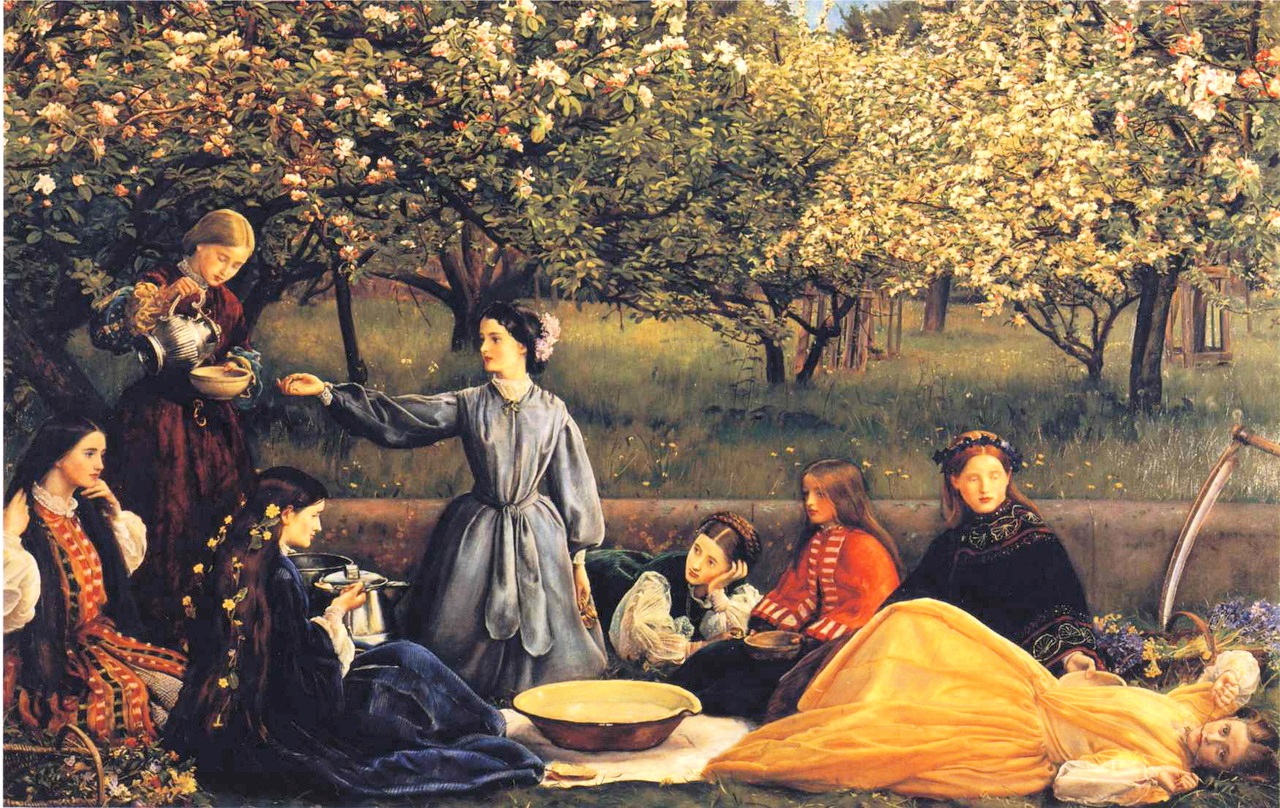
Spring (Apple Blossoms) by John Everett Millais, around 1856-9
From: Wikimedia Commons

Wednesday, February 23, 2011

At the Time Appointed

By A. Maynard Barbour
Published in 1903 (Grosset & Dunlap)

A western novel among the mines. I originally wrote this post in October and revised it today. There was no real need, I admit, to give so many half-digested details of the plot but at any rate it's historical source material.

Tuesday, February 22, 2011

A Pynche of Levitee

Since I am presently too lazy to reread Suetonius and write something intelligent, and since I would like to share the post irrespective of the weekday theme, here is a link to an interview — both contemporary and premodern — between Margaret Atwood and the mind behind Geoffrey Chaucer Hath a Blog, conducted in the late 14th century idiom.

Interview wyth Margarethe Atte-Woode

Via @MargaretAtwood

Friday, December 10, 2010

A Song of Autumn

Paul Verlaine (1844-1896)
French poet.

CHANSON D'AUTOMNE

Les sanglots longs
Des violons
De l'automne
Blessent mon coeur
D'une langueur
Monotone.

Tout suffocant
Et blême, quand
Sonne l'heure,
Je me souviens
Des jours anciens
Et je pleure;

Et je m'en vais
Au vent mauvais
Qui m'emporte
Deçà, delà,
Pareil à la
Feuille morte.
***

The long-drawn sobs
of the violins
of autumn
wound my heart
with monotonous
languor.

All suffocated,
pallid, when
the hour sounds,
I remember
days past
and I weep.

And I depart
on the miscreant wind
which bears me
thither, hither,
much like the
dead leaf.

(My spur-of-the-moment translation, without the rhyme of the original. Besides, a tip of the hat to Marie.)

***

From: Oeuvres de Paul Verlaine [Gutenberg.org]